Rules
PROPOSED RULE CHANGE 4.3.B.pdfBPGCD_Rules_formatted_v20260501.pdfFee SchedulePROPOSED RULE AMENDMENTS 20260716.pdf
Rule 1 Introduction.. 1
1.1 Authority to Promulgate Rules. 1
1.3 Resident Petition Process for Rule Adoption. 3
Rule 2 Definitions. 7
Rule 3 Well Registrations, Well Drilling Authorizations, and Operating Permits. 19
3.1 Wells Subject to Operating Permits and Exemptions. 20
A. Requirement to Obtain an Operating Permit. 20
B. Wells Exempt from Obtaining an Operating Permit. 20
C. Edwards-Trinity, Upper Glen Rose, and Marble Falls Aquifer Wells. 23
3.2 Existing Well Definition, Registration, and Operating Permit Requirements. 23
A. Existing Well Registration, Classification, and Authorization for Changes. 23
B. Existing Well Operating Permit Determination. 24
3.3 Well Registration, Drilling Authorization, and Test Well Procedures. 25
A. Written Authorization Requirement for New Wells and Status Changes. 25
B. Definition of a New Well 25
C. Mandatory Pre-Drilling Registration for New Wells in Blanco County. 25
D. Obligation to Provide All Required Information on Registration Forms. 25
E. Registration Fee Requirement for New Wells. 25
F. Temporary Well Number Assignment Pending State Designation. 25
G. Well Registration Approval and Drilling Authorization Requirements. 26
H. Drilling Authorization, Construction Compliance, and Reporting Deadlines. 26
I. Test Well Exemption and Conversion Requirements. 26
A. Operating Permit Application Requirements and Documentation. 27
B. Administrative Completeness, Notice, and Application Expiration. 31
C. Operating Permit Application Review and Criteria. 32
D. Operating Permit Provisions: Board Action and Special Conditions. 34
3.5 Operating Permit Review, Amendment, Revocation, and Status Changes. 36
A. Periodic Permit Review and Compliance Determination Procedures. 36
B. Operating Permit Involuntary Amendment or Revocation. 37
C. Change of Well Ownership. 37
D. Change in Well Condition, Operation or Status. 37
E. Registration and Permit Application Fees. 39
A. Requirements and Application Completeness Procedures. 40
B. Export Facility Registration and Permit Application Details. 40
C. Factors for Board Consideration. 42
D. Standard Terms and Provisions. 42
E. Acceptance Constitutes Agreement to Comply with All Rule Terms. 43
F. Transportation Facilities: Monitoring, Reporting, and Fee Requirements. 45
G. Pollution Prevention and Public Health Protection. 46
H. Transportation Facilities: Reimbursement of Administrative Expenses. 47
I. Term Duration and Construction-Based Extensions. 47
J. Export Permit Review and Authority to Revise Transfers. 47
K. Renewal Application Deadline and Term Continuity. 48
L. Concurrent Board Consideration of Export and Well Permit Applications. 48
M. Prohibition Against Fraudulent Information. 48
N. Application Fee Payment Requirements. 48
A. Pre-Expiration Permit Renewal and Change Notifications. 49
B. Continuity During Renewal Consideration and Application Requirements. 49
C. Expedited General Manager Approval for Unchanged Permit Renewals. 49
D. General Manager Restrictions on Operating Permit Renewal Approval 50
E. Hearing Requirements for Renewal Amendments and Denial Consequences. 50
F. Continuation of Existing Terms During Amendment Proceedings. 51
G. District-Initiated Permit Amendments and Withdrawal Adjustments. 51
H. Renewal Procedures and Automatic Term Extension 52
Rule 4 Well Standards, Spacing, and Reporting Requirements. 53
4.1 Groundwater Production Reporting and Monitoring. 53
A. Notification Required Prior to Drilling and Pump Installation. 53
B. Well Drilling and Completion Reports. 53
C. Spacing from Potential Sources of Contamination. 57
D. Spacing from Retail Public Utility Service Area or Community Water System... 57
4.3 Well Construction Standards. 58
A. Mandatory Watertight Sanitary Seal Requirements for Wellheads. 59
B. Enhanced Grouting and Aquifer Isolation Standards. 59
C. Inspection Access Requirements. 60
D. Vent Installation and Removability Requirements for Inspection Ports. 60
E. Inspection Tube Installation Requirements for Wells with Centralizers. 60
4.4 Sealing, Capping, or Plugging Wells. 61
4.5 Access: Well and Property 63
Rule 5 Groundwater Management Strategies. 65
5.1 Groundwater Database and Scientific Investigations. 65
A. Well and Aquifer Database Management for Science and Planning. 65
B. Research Projects and Well Owner Cooperation. 65
C. Joint Planning and Desired Future Conditions. 66
5.2 Establishment of a Critical Groundwater Depletion Area. 66
A. Designation of a Critical Groundwater Depletion Area. 67
B. Critical Groundwater Depletion Area Designation Procedures. 67
C. Administration of a Critical Groundwater Depletion Area. 68
5.3 Declaration of an Aquifer Emergency Warning. 72
A. Declaration for Hazardous Groundwater Conditions. 72
B. Notification Procedures. 72
C. Notification and Protective Guidance for High-Risk Property Owners. 73
D. Mandatory Public Meeting Within 14 Days of Emergency Declaration. 73
E. Post-Emergency Investigation and Analysis of Hazardous Conditions. 73
F. Duration and Cancellation of Aquifer Emergency Warnings. 74
Rule 6 Groundwater Conservation.. 75
E. Orders to Prevent Waste or Pollution. 75
Rule 7 Drought Management. 77
7.3 Drought Management by Watershed. 78
B. Pedernales River Watershed: 79
7.4 Triggering Criteria for Initiation and Termination of Drought Stages. 81
A. Initiation of Drought Stages. 81
B. Termination or Reduction of Drought Stages. 82
A. Stage One: Mild Drought. 82
B. Stage Two: Moderate Drought. 83
C. Stage Three: Severe Drought. 83
D. Stage Four: Critical Drought or Groundwater Emergency. 83
7.6 Groundwater Conservation Goals and Usage Reduction Measures. 83
A. Stage One: Mild Drought. 83
B. Stage Two: Moderate Drought. 84
C. Stage Three: Severe Drought. 85
D. Stage Four: Critical Drought or Groundwater Emergency. 86
Rule 8 Procedural Rules. 88
8.2 Hearings Other Than Permit Hearings or Emergency Rules. 88
A. Public Hearings for Rules and Depletion Area Proposals. 88
B. Comprehensive Notice Requirements for Contested Case Hearings. 88
C. Public Hearing Notice Content for Rules and Depletion Areas. 89
D. Public Availability of Proposed Rules and Depletion Area Plans. 89
E. Annual Request Requirement for Individual Hearing Notices. 89
F. Deadline for Written Comments on Proposed Rules and Depletion Areas. 90
G. Oral Comment Opportunity at Public Hearings. 90
H. Hearing Compliance and Audio Recording Requirements. 90
I. Written Order and Attachment Requirement for Board Decisions. 90
J. Effective Date and Finality of Board Orders on Proposals. 90
8.3 Adoption of Emergency Rules. 91
A. Emergency Rule Adoption Without Standard Notice and Hearing. 91
B. Open Meetings Act Requirement for Emergency Rule Adoption. 91
C. An emergency rule shall be effective for 90 days. 91
8.4 Permit Actions by the Board. 92
A. Public Hearing Scheduling Deadline for Complete Applications. 92
B. Public Hearing Notice Requirements and Content. 92
C. Applicant Publication and Website Posting for Hearing Notice. 92
D. Mailed Notice to Applicant and Amendment Reprocessing. 92
E. Public Availability of Application Materials Prior to Hearing. 93
F. Public Comment Opportunities on Permit Applications. 93
G. Board Discretion to Administer Oaths During Application Hearings. 93
H. Board Decision Timeline, Order Requirements, and Possible Outcomes. 93
I. Contested Case Appeal Process for Denied or Conditional Permits. 94
J. Pre-Hearing Conference for Contested Case Requests. 94
8.5 Permit Actions Requiring a Contested Case Hearing. 95
A. Timely request for contested case hearing. 95
C. The evidentiary hearing must be conducted by: 95
D. Presiding Officer: Authority and Obligations. 97
E. Hearing Record Requirements and Cost Allocation. 99
F. Hearings Examiner Report Requirements and Exceptions. 99
G. Board Decision Timelines and Order Requirements. 100
H. Procedures and Deadlines for Rehearing Requests and Findings. 101
I. Conditions for Finality of Board Decisions. 102
J. Judicial Appeal Deadline and Rehearing Prerequisite. 102
8.6 Hearings On Enforcement Actions. 103
A. Enforcement, Scheduling, and Public Hearings. 103
B. Open Meetings Law Notice Requirement. 103
C. Certified Mail Notice Requirement for Enforcement Hearings. 103
D. Opportunity for Oral Comments at Enforcement Action Meetings. 103
E. Board Discretion to Administer Oaths During Enforcement Actions. 104
F. Appointment of Hearing Officer or Committee for Enforcement Actions. 104
G. Written Order or Resolution Requirement for Board Decisions. 104
H. Effective Date and Finality of Board Orders. 104
Rule 9 Enforcement. 105
9.1 Enforcement Policy in General 105
Public Participation Form... 108
1.1 Authority to Promulgate Rules
The Blanco-Pedernales Groundwater Conservation District (BPGCD or District) is a political subdivision of the State of Texas. On October 11, 2000, the Texas Natural Resource Conservation Commission (now the Texas Commission on Environmental Quality), in accordance with applicable provisions and requirements of the Texas Water Code, approved a petition for the creation of the District. In a confirmation election held on January 23, 2001, Blanco County voters approved the creation of the District, elected five Directors to the Board of Directors, and approved its authority to assess an ad valorem tax on the Blanco County property owners. As a duly created groundwater conservation district, the District may exercise any and all statutory authority or power conferred under Chapter 36 of the Texas Water Code, including the adoption and enforcement of rules under Section 36.101 Rule Making Power. All references to statutory provisions in these Rules are to the Texas Water Code, as amended, unless otherwise specifically stated.
The District is located within the Hill Country Priority Groundwater Management Area (PGMA), which was designated and delineated in 1990 by the Texas Natural Resource Conservation Commission under Chapter 35 as an area experiencing or expected to experience critical groundwater problems.
1.2 Purpose of the Rules
The District Rules are promulgated under the District’s statutory authority to make and enforce rules to provide for the conservation, preservation, protection, and recharge of groundwater and aquifers within Blanco County in order to protect property rights, balance the conservation and development of groundwater to meet the needs of this State, and use the best available science in the conservation and development of groundwater. These Rules are intended to implement the management strategies and policies incorporated in the District Groundwater Management Plan. These Rules are also intended to minimize the drawdown of the water table, minimize the reduction of artesian pressure, control subsidence, prevent interference between wells, prevent the degradation of the quality of groundwater, prevent waste of groundwater, preserve historic use of groundwater, give consideration to the service needs of retail public utilities, and carry out the powers and duties conferred under Chapter 36.
These Rules, and any orders, regulations, requirements, resolutions, policies, directives, standards, guidelines, management plan, or other regulatory measures implemented by the Board, have been promulgated to fulfill these objectives. These Rules may not be construed to limit, restrict, or deprive the District or Board of any exercise of any power, duty, or jurisdiction conferred by Chapter 36 or any other applicable law or statute. The Board shall develop rules that are fair and impartial, and shall consider all groundwater uses and needs.
The Board is authorized to make and enforce rules limiting groundwater production based on tract size or the spacing of wells.
1.3 Resident Petition Process for Rule Adoption
(A) A person with a real property interest in groundwater in the District may file a petition with the District to request the adoption of a rule.
(B) Petitions must be submitted in writing to the District office and must comply with the following requirements:
(1) Each rule requested must be submitted by a separate petition;
(2) Each petition must be signed and state the name and address of each person signing the petition;
(3) Each petition must include:
(a) a brief description of the petitioner’s real property interest in groundwater in the District;
(b) a brief explanation of the proposed rule;
(c) the text of the proposed rule prepared in a manner to indicate the words to be added or deleted from the text of the current rule, if any; and
(d) an allegation of injury or inequity that could result from the failure to adopt the proposed rule.
(C) The General Manager may reject any petition for failure to comply with the requirements of Subsection (B) of this section and shall provide notice to the petitioner of the reason for the rejection.
(D) Within 90 days after submission of a petition that complies with this section, the Board shall either deny the petition, stating its reasons for denial in the minutes of the board meeting or in a letter providing a written explanation to the petitioner, or initiate rulemaking proceedings as provided by Section 36.101, Water Code.
(E) The Board may, following notice and hearing, amend these Rules or adopt new rules from time to time.
(F) These Rules and any amendments thereto are effective upon adoption unless otherwise indicated in the adoption resolution.
1.4 Severability
If any Rule, provision, section, sentence, paragraph, clause, word, or other portion of these Rules is for any reason held to be invalid, illegal, or unenforceable in any respect, the invalidity, illegality, or unenforceability does not affect any other Rules or portions thereof, and these Rules shall be construed as if such invalid, illegal, or unenforceable Rule or of portions thereof had never been contained herein.
1.5 Regulatory Compliance
All Blanco County wells and well owners, well drillers, pump installers, and others under the jurisdiction of the District shall comply with all applicable Rules, orders, regulations, requirements, resolutions, policies, directives, standards, guidelines, or any other regulatory measures implemented by the District.
1.6 Variances
The District may grant an exception to requirements or provisions of the Rules to the extent allowed by Texas Water Code Chapter 36. A person desiring a variance shall submit a written request with supporting information and rationale. The General Manager may act on the request or refer the matter to the Board for consideration. If requested by any affected or potentially affected person, the General Manager shall refer the matter to the Board for consideration. Consideration by the Board shall be in accordance with Rule 8.4. At the next available Board meeting, the General Manager shall report on any variances granted.
1.7 Administrative Fees
Section 36.205 authorizes the District to assess fees for administrative acts of the District. These fees may not unreasonably exceed the cost to the District of providing the administrative function for which the fee is charged. Fees shall be assessed in accordance with the District Fee Schedule set by the Board. A copy of the Fee Schedule may be obtained from the District Office.
1.8 Computing Time
In computing any period of time prescribed or allowed by these Rules, by order of the Board, or by any applicable statute, the day of the act, event, or default from which the designated period of time begins to run, is not to be included, but the last day of the period so computed is to be included, unless it be a Saturday, Sunday, or legal holiday on which the District is closed, in which event the period runs until the end of the next day that is neither a Saturday, Sunday, or a legal holiday on which the District is closed.
1.9 Time Limits
Applications, requests, or other papers or documents required or permitted to be filed under these Rules must be received for filing at the District, within the time limit, if any, for such filing. The date of receipt and not the date of posting is determinative.
1.10 Regulatory Control
Where District Rules and regulations are more stringent than those of other governmental entities, the District Rules and regulations shall control, provided the rules and regulations are within the scope of the District’s statutory authority and are not otherwise preempted by state or federal law.
Unless the context indicates a contrary meaning, the words hereinafter defined shall have the following meanings in the Rules of the Blanco-Pedernales Groundwater Conservation District:
Abandoned Well – a well, including a cistern or a hand-dug well, that for at least one year: (1) has been left unused, unattended, and improperly protected from contamination or sources of pollution; (2) has not been used for a beneficial purpose; or (3) is not registered with the District.
Adverse Groundwater Conditions – a condition in which an aquifer or portion of an aquifer is experiencing aquifer mining, deteriorating water quality, or other conditions that may harm or threaten to harm the health, safety, and welfare of well owners and aquifer users.
Affected person - a person who has a personal justiciable interest related to a legal right, duty, privilege, power, or economic interest affected by any application to the District, which is not an interest common to members of the general public.
Aggregate Wells – a multi-well system comprised of two or more wells that are owned by the same owner and serve the same property, subdivision, facility, or customers.
Aggregate Withdrawal – the amount of water withdrawn from two or more permitted wells owned by the same owner that is permitted for a total annual production amount of all wells in the aggregate.
Annular Space – the space between two concentric cylindrical objects, one of which surrounds the other, such as the space between the walls of a drilled hole and the installed casing.
Aquifer – a geologic formation that will yield water to a well in sufficient quantities to make the production of water from this formation feasible for beneficial use.
Aquifer Emergency Warning – an action taken pursuant to Rule 5.3 of these Rules when the District has determined that hazardous groundwater conditions exist requiring immediate action on the part of the District.
Aquifer Mining – a condition where the average available recharge of an aquifer or portion of an aquifer is less than the annual production from that aquifer or that portion of that aquifer.
For purposes of these Rules, the terms “aquifer overdrafting,” “reduction of artesian pressure,” “subsidence”, the “drawdown of the water table or aquifer” shall mean aquifer mining when the condition results from groundwater production.
Artesian Pressure – where water is confined in an aquifer under pressure so that the water will rise in the well casing or drilled hole above the bottom of the confining bed overlying the aquifer.
Beneficial Use – the use of groundwater (1) for domestic, municipal, stock raising, agricultural use or purpose, industrial, mining, manufacturing, irrigation, gardening, and pleasure/recreational purposes; (2) for exploring for, producing, handling, or treating oil, gas, sulfur, or other minerals; or (3) for any other purpose that is useful and beneficial to the user except when such use or purpose falls under the definition of “Waste” as defined in these Rules or Chapter 36.
Board – the elected or duly appointed Board of Directors of the Blanco-Pedernales Groundwater Conservation District.
Capping – equipping a well with a securely affixed, removable device that will prevent the entrance of surface pollutants into the well.
Casing – a tubular structure installed in the excavated or drilled borehole to maintain the well opening.
Change in Well Condition, Operation or Status – to alter the physical or mechanical characteristics of a well, its equipment, its use, or production capabilities. This does not include repair of well equipment, well houses or enclosures, or replacement with comparable equipment.
Cistern – an in-ground storage facility for water. See also abandoned well.
Community Water System – a public water system that has the potential to serve at least 15 residential connections on a year-round basis or serves at least 25 residents on a year-round basis. (See also “Retail Public Utility”).
Conservation – those water saving practices, techniques, and technologies that will reduce the consumption of water, reduce the loss or waste of water, improve the efficiency in the use of water, or increase the recycling and reuse of water so that a water supply is made available for future or alternative uses.
Critical Groundwater Depletion Area or (CGDA) – a CGDA is any portion of the District which is so designated and delineated by the Board according to Rule 5.2.
Desired Future Conditions or DFC – a physical condition of an aquifer that is designated in accordance with Chapter 36.108 by the Groundwater Management Area joint planning process as being an acceptable or desirable condition of the aquifer at one or more specified future times.
Director – an elected or appointed member of the Board of Directors of the BPGCD.
Discharge – the volume of water that passes a given point within a given period of time or the amount of water that leaves an aquifer by natural or artificial means.
District – the Blanco-Pedernales Groundwater Conservation District (BPGCD) or one of its authorized representatives.
District Monitor Well – a well designated as such by the District which is used for specific District needs or programs such as water quality monitoring, measuring aquifer levels, or determining Drought Conditions.
District Office – the main office of the District at such location as may be established by the Board.
Domestic Use – the use of groundwater for personal needs or for essential household purposes such as drinking, bathing, heating, cooking, sanitation or cleaning; swimming pools, irrigation of lawns, shade trees, non-commercial family gardens and orchards; watering of domestic animals; and maintaining up to 50,000 gallons of groundwater storage in ponds, lakes, tanks, reservoirs, or other surface impoundments for holding water located on the person’s property.
Drill – drilling, digging, equipping, completing wells, or changing the size of wells or well pumps/motors (resulting in an increase in production volume capability) whereby a drilling or service rig must be on location to perform the activity.
Drought – a prolonged period of time in which no substantial rainfall and surface water runoff occurs or aquifer discharge exceeds recharge.
Existing Well – any well in the District that was drilled or dug on or before February 11, 2002.
Export Permit - a permit issued by the District authorizing transfer of groundwater outside the District’s boundaries.
Fees – charges imposed by the District pursuant to Texas Water Code Chapter 36.
Groundwater Management Area or GMA – one of 16 state-designated areas based generally on boundaries of the major and minor aquifers. Groundwater Districts within a GMA are required to participate in joint planning and designate DFCs for relevant aquifers. The BPGCD is part of GMA-9.
Groundwater Management Plan – a management plan developed by the District pursuant to Section 36.1071.
Groundwater – water percolating beneath the earth’s surface.
Groundwater Reservoir – a specific subsurface water-bearing reservoir having ascertainable boundaries and containing groundwater.
Hand-Dug Well – A well installed by hand digging or by auger drilling.
Hazardous Groundwater Conditions – a groundwater quality condition as described in Rule
5.3.A. that may be detrimental to the health, safety, and welfare of the residents or livestock of Blanco County.
Industrial Use – use of groundwater primarily in the building, production, manufacturing, or alteration of a product or goods, or to wash, cleanse, cool, or heat such goods or products.
Irrigation Use – use of groundwater to supply water for application to plants or land in order to promote growth of plants, turf, or trees, other than for domestic use.
Livestock Use – the use of groundwater to provide water for domesticated horses, cattle, goats, sheep, swine, poultry, ostriches, emus, rheas, fish, exotic deer and antelope, and other similar animals involved in farming or ranching operations, including maintaining up to 50,000 gallons of groundwater storage in ponds, lakes, tanks, reservoirs, or other surface impoundments for holding water located on the person’s property. Dogs, cats, birds, reptiles, small mammals, potbellied pigs, and other animals typically kept as domestic pets are not considered livestock. Livestock-type animals kept as pets or in a pet-like environment are not considered livestock.
Modeled Available Groundwater – means the amount of water that the Texas Water Development Board Executive Administrator determines may be produced on an average annual basis to achieve a desired future condition established under Section 36.108, Water Code.
Monitor Well – a well generally used for collecting water-quality or water level data.
New Well – a well drilled or dug after February 11, 2002.
Notice of Violation – written notice from the District notifying a person that they are in violation of law, including violation of a District Rule, Order, or permit.
Open or Uncovered Well – a well that is not closed, capped, or covered as required by the District.
Operate or Operations – to produce or cause to produce water from a well.
Operating Permit – the authorization issued by the District under which an owner of the property may operate and produce water from a nonexempt well within the District in compliance with approved District Rules, and may specify the amount of groundwater authorized to be withdrawn annually, the rate of withdrawal in gallons per minute, the purpose of use, the place of use, and the point of withdrawal.
Owner or Well Owner – any person who owns or has the right to drill a well on a tract of land or to produce groundwater from the land, either by ownership, contract, lease, easement, or any other estate in the land.
Permitted Well – a well for which an Operating Permit has been issued by the District.
Permittee – a person who has a permit issued by the District.
Person – includes a corporation, individual, organization, cooperative, government or governmental subdivision or agency, business trust, estate, trust, partnership, association, or any other legal entity.
Plugging – the permanent closure of a well in accordance with approved State and District standards.
Presiding Officer – the Board President or hearings examiner, or if the Board President is not present, the director selected by the other directors to serve as Presiding Officer.
Production – all water withdrawn from the ground, measured at the wellhead. See also definition of “withdrawal.”
Public Water Supply – a system as defined in 30 Texas Administrative Code Chapter 290 for providing water for human consumption to the public (See also “Retail Public Utility”).
Rate of Withdrawal – the volume of water a well can produce during a specific period of time (gallons per minute, gallons per day, etc.) as determined by either the rated pumping capability of the installed pump or as measured by the District.
Recharge – the amount of water that infiltrates to the water table of an aquifer.
Recharge Zone – the land surface area in which water infiltrates permeable rock layers that provide a flow path for water to enter an aquifer.
Recovery Well – a well constructed for the purpose of recovering undesirable groundwater for treatment or removal of contamination.
Retail Public Utility – as defined by Texas Water Code Section 13.002 and 30 Texas Administrative Code Sections 290 and 291, any person, corporation, public utility, water supply corporation, municipality, political subdivision, or agency operating, maintaining, or controlling, within Blanco County, facilities for providing potable water service for compensation. (See also “Public Water Supply”).
Rules – standards and regulations promulgated by the District.
State Office of Administrative Hearings or SOAH – the state agency created under Chapter 2003, Government Code, to serve as an independent forum for the conduct of adjudicative hearings in the executive branch of state government.
Seal – an official seal, tag, or label placed on a well or its equipment, or the act of placing the tag or label, to indicate that further pumping of groundwater, or operation of the well, or continuing with other District regulated activities is not permitted by the District, shall be in violation of District Rules, and may subject the well owner to civil suit or penalties. Also, the official District seal adopted by the Board of Directors.
Special Permit Conditions – conditions or requirements added to a permit, which may be more or less restrictive than the Rules as a result of circumstances unique to a particular situation.
Spring – a point of natural discharge from an aquifer (may incorporate man-made structural features such as spring houses, retaining walls, settling ponds, pipes, etc.).
State of Texas Well Report or Well Log – the report that every well driller who drills, deepens, or alters a well is required to complete under the Texas Department of Licensing and Regulation Rules, as defined in 16 Texas Administrative Code Sections 76.10 and 76.700, including any special purpose geophysical log that may be available for any given well, such as a gamma ray log, a temperature log, an electric log, or a caliper log.
TCEQ – Texas Commission on Environmental Quality.
Transportation Facility or Transportation facilities – the pump stations, water truck, pipelines, storage tanks, or other water transportation systems used to move groundwater.
Test Well – a well drilled for purposes of testing water availability or quality.
Waste – any one or more of the following:
(1) The withdrawal of groundwater from a groundwater reservoir at a rate and in an amount that causes or threatens to cause intrusion into the reservoir of water unsuitable for agricultural, gardening, domestic, or stock raising purposes.
(2) The flowing or producing of wells from a groundwater reservoir if the water produced is not used for a beneficial purpose.
(3) The escape of groundwater from one groundwater reservoir to any other reservoir or geologic strata that does not contain groundwater.
(4) The pollution or harmful alteration of groundwater in a groundwater reservoir by saltwater or by other deleterious matter admitted from another stratum or from the surface of the ground.
(5) Willfully or negligently causing, suffering, or allowing groundwater to escape into any river, creek, natural watercourse, depression, lake, reservoir, drain, sewer, street, highway, road, or road ditch, or onto any land other than that of the owner of the well unless such discharge is authorized by permit, rule, or order issued by the commission under Chapter 26, Water Code.
(6) Groundwater pumped for irrigation that escapes as irrigation tailwater onto land other than that of the owner of the well unless permission has been granted by the occupant of the land receiving the discharge.
(7) Unless the water from an artesian well is used for a purpose and in a manner in which it may be lawfully used on the owner’s land, it is waste and unlawful to willfully cause or knowingly permit the water to run off the owner’s land or to percolate through the stratum above which the water is found.
(8) Drilling a well without a required permit or operating a well at a higher rate of production than the rate approved for the well.
Water Table – the upper boundary of the saturated zone in an unconfined aquifer.
Water Well – an artificial excavation constructed to explore for or produce groundwater.
Well – water well, test well, dewatering well, or monitoring well.
Well Log – Same as State of Texas Well Report - an accurate record made during drilling on a form prescribed by the Water Well Drillers Rules (16 Texas Administrative Code Chapter 76), showing the depth of the well bore, thickness of the formations, character of casing installed, and any other data required by the Water Well Drillers Rules. It also includes any special purpose well log that may be available for any given well, such as a gamma ray log, a temperature log, an electric log, or a caliper log.
Withdraw or Withdrawal – the act of extracting groundwater by pumping or any other method, other than the discharge of natural springs.
All wells located in Blanco County shall be registered with the District in accordance with Rule
3.2.A or 3.3, and shall comply with all State and District well construction requirements. Based on the registration information, certain well owners will be required to obtain Operating Permits.
The decision whether to grant or deny an Operating Permit required under these Rules, shall be based on the considerations required by 36.113(d) and Rule 3.4.C. As authorized by Section 36.113(f), all permits issued by the District shall be subject to the District Rules and to terms and conditions regarding the drilling, equipping, completion, or alteration of wells or pumps that may be necessary to prevent waste and achieve water conservation, minimize as far as practical the drawdown of the water table or the reduction of artesian pressure, lessen interference between wells, or control and prevent subsidence.
The District reserves the authority, to the extent allowed by law, to adopt, revise, and supersede its Rules applicable to wells subject to registration and permitting. Registration of a well, issuance of a well drilling authorization, or Operating Permit does not limit the District’s authority to regulate a well or the production of water from a well.
The District may conduct well and well site inspections as part of the registration, application, drilling, or completion process or to confirm well location, status, pumping capability, measure water levels, take water samples, conduct geophysical well logging, or other appropriate well-related investigations and inspection activities deemed necessary by the District. All well and well site access shall be conducted in accordance with Rule 4.5.
3.1 Wells Subject to Operating Permits and Exemptions
Operating Permits are issued by the District in accordance with Texas Water Code Chapter 36, District Rules, and the District Groundwater Management Plan (GMP). The Modeled Available Groundwater is a result of Texas Water Code Chapter 36.108 requirements for regional planning, cooperation, and coordination with other Groundwater Conservation Districts located in Groundwater Management Area 9 and counties adjacent to Blanco County.
Exemptions granted by the District Rules or Chapter 36, Water Code, do not grant exemptions from other State or local regulations.
A. Requirement to Obtain an Operating Permit
A well, regardless of the type of use of the water, that is equipped with a pump that is capable of producing more than 25,000 gallons per day (17.36 gallons per minute), shall obtain an Operating Permit. A well flow rate must be measured as the water leaves the production pipe at the well head and before the installation of any subsequent plumbing or other related devices.
B. Wells Exempt from Obtaining an Operating Permit
(1) A well, or aggregate wells used for domestic use, or for providing water to livestock, poultry, or wildlife, if the well is drilled, completed, or equipped so that the well or aggregate wells are incapable of producing more than 25,000 gallons per day (17.36 gallons per minute) in aggregate, are exempt from the requirement to obtain an operating or export permit, but may be subject to other rules of the District.
(2) A well used solely to supply water for a rig that is actively engaged in drilling or exploration operations permitted by the Railroad Commission of Texas provided that the person holding the permit is responsible for drilling and operating the water well and the well is located on the same lease or field on which the drilling rig is located or is in close proximity to the drilling rig. The District may not deny an application for a permit for any well used to supply water for hydrocarbon production activities if the application is in compliance with the spacing, density, and production Rules applicable to all permitted water wells of the District. The District shall require such a well, if converted to a non-exempt use, to be permitted and comply with District Rules if the well is no longer solely used to supply water for a rig actively engaged in drilling or exploration operations.
(3) A well authorized under a permit issued by the Railroad Commission of Texas under Chapter 134, Natural Resources Code, or for production from such a well to the extent the withdrawals are required for mining purposes regardless of any subsequent use of the water. These water wells are not required to comply with the spacing requirements of the District. The District shall require a well to be permitted and comply with District Rules if the withdrawals from the well are no longer necessary for mining activities, or are greater than the amount necessary for mining activities specified in the permit issued by the Railroad Commission of Texas under Chapter 134, Natural Resources Code. An entity holding such a Chapter 134 permit for a water well shall report monthly to the District (1) the total amount of water withdrawn during the month; (2) the quantity of water necessary for mining activities; and (3) the quantity of water withdrawn for other purposes.
(4) A temporary water well used solely to supply water for a rig that is actively engaged in drilling a groundwater production well permitted by the District.
(5) A well drilled and completed solely for purposes of aquifer testing, including a test well, or for monitoring water levels or water quality. Every effort must be made to use any water produced during testing for a beneficial purpose. Wells drilled under this exemption that are subsequently converted to another use must submit a “Change in Well Condition, Operation or Status” form obtained from the District in accordance with Rule 3.5.C Conversions to a non-exempt use are subject to the Operating Permit requirements.
(6) The exemptions in Sec. 36.117, Water Code, apply to wells in the District as long as the groundwater usage meets the qualifications provided in the Water Code.
C. Edwards-Trinity, Upper Glen Rose, and Marble Falls Aquifer Wells
In accordance with the District Groundwater Management Plan, the District will not issue an Operating Permit for a new well proposed to withdraw groundwater from the Edwards-Trinity (Plateau), Upper Glen Rose (Upper Trinity), or Marble Falls Aquifers.
3.2 Existing Well Definition, Registration, and Operating Permit Requirements
Any well in the District that was drilled on or before February 11, 2002, is an existing well under these Rules. Owners of all existing wells are required to register the wells with the District. Owners of some existing wells are also required to obtain an Operating Permit for the wells from the District.
A. Existing Well Registration, Classification, and Authorization for Changes
The owner of an existing well located in Blanco County shall register the well with the District. Forms for registering an existing well are available from the District Office. The owner shall provide all information required on the form, if known or available, and a copy of the completed State of Texas Well Report, if available.
No fee may be charged for registering an existing well. The well shall be registered under its existing State well number. If the well does not have a State well number, the District shall issue a temporary well number pending assignment of a State well number. The District shall also determine whether the well is currently operational, abandoned, plugged, or capped. If the District determines that no Operating Permit is required, no further approval is required of existing wells, except as may be required by Rule 3.5.C or 3.5.D regarding changes in ownership or well conditions. Subsequent changes in the annual amount of withdrawal, rate of withdrawal, or purpose of use of water from a registered well may result in the well-being reclassified as non-exempt, which would require the well owner to apply for an Operating Permit. The owner of an existing registered well that proposes to change the annual amount of withdrawal, rate of withdrawal, or purpose of use of water from a registered well shall seek authorization from the District prior to making such changes.
B. Existing Well Operating Permit Determination
The District shall determine whether the existing well must obtain an Operating Permit.
3.3 Well Registration, Drilling Authorization, and Test Well Procedures
A. Written Authorization Requirement for New Wells and Status Changes
Written authorization must be obtained from the District before a new well is drilled or an existing registered well changes conditions, operations, or status.
B. Definition of a New Well
A new well is a well drilled after February 11, 2002.
C. Mandatory Pre-Drilling Registration for New Wells in Blanco County
The owner of a new well proposed to be located in Blanco County must register the well with the District prior to commencement of drilling. This registration shall serve as an application for a well drilling authorization. Forms for registering a new well are available from the District Office.
D. Obligation to Provide All Required Information on Registration Forms
The owner shall provide all information required on the form, if known or available.
E. Registration Fee Requirement for New Wells
The Registration Fee listed on the current District Fee Schedule shall be charged for registering a new well.
F. Temporary Well Number Assignment Pending State Designation
The District will issue a temporary well number pending assignment of a State well number.
G. Well Registration Approval and Drilling Authorization Requirements
If the District determines that the information is complete, the registration fee has been paid, the location of the proposed well complies with Rule 4.2 spacing requirements, and the registrant is in compliance with all District Rules, the District will issue a well drilling authorization. If an Operating Permit is required, the owner must obtain an Operating Permit prior to producing water from the well, other than for testing purposes.
H. Drilling Authorization, Construction Compliance, and Reporting Deadlines
The registrant may begin drilling immediately upon receiving the approved registration and well drilling authorization. The well must comply with all State and District well construction and spacing requirements. The owner shall ensure that the driller files a copy of the State of Texas Well Report with the District within 60 days of completion.
I. Test Well Exemption and Conversion Requirements
A test well is exempt from obtaining an Operating Permit. Once testing is concluded, the well must either be properly plugged or the owner must submit a “Change in Well Condition, Operation or Status” application form to convert the well to a different use. In the case of conversion to a non-exempt use, the owner must obtain an Operating Permit. Authorization to drill a test well does not guarantee issuance of an Operating Permit for that well.
3.4 Operating Permits
If, based on the registration submitted, the well test results or capacity after well completion, an Operating Permit is required under current District Rules, the owner is required to make application for an Operating Permit.
A. Operating Permit Application Requirements and Documentation
(1) An application for an Operating Permit for a non-exempt well must be submitted to the District in writing and be sworn to by the well owner. The application must be submitted on forms obtained from the District and include all the information required by this rule. A separate application is required for each well, although the District may issue aggregate permits.
(2) Application Fees will not be charged for Operating Permit applications for any non-exempt Existing Wells. Each application for a new permit must be accompanied by payment of the Operating Permit Application Fee listed on the current District Fee Schedule.
(3) The applicant must provide sufficient documentation to the District to show that the applicant has a real and current need for the quantity of groundwater requested in the application within one year following the date of application.
(4) An application for an Operating Permit for a well to be drilled after the effective date of these rules or to alter a well, or an amendment to an existing Operating Permit, requesting an annual groundwater withdrawal volume of 10,000,000 gallons or more, must include results of a hydrogeological test as part of the application submission. The aquifer test must be performed on existing or test wells located or drilled on the property in question and must be conducted and reported in accordance with hydrogeological testing procedures acceptable to the District. The aquifer test and subsequent report must be conducted and prepared by either a registered Professional Engineer or a registered Professional Geoscientist.
(5) The application must include the following information unless waived by the General Manager:
(a) The well owner’s name, mailing address, physical address, phone number, email address, a contact person (if different from the well owner), and the same information for the well operator (if different from the well owner).
(b) The annual groundwater withdrawal amount requested along with documentation justifying that amount as reasonable for the requested purpose of use, the maximum rate of withdrawal, the place of use (described by physical address, metes and bounds, or legal description), the purpose of use, and the location or proposed location of the well or wells (described by physical address or latitude and longitude). The application must state if the proposed purpose of use of water from the well is wholly or partly to provide water to a pond, lake, or reservoir to enhance the appearance of the landscape.
(c) If the permit is to include a well field or aggregate system, the total number and location of all wells.
(d) A water conservation plan and a drought plan.
(e) A property plat, survey, or map of the parcel showing the location of the proposed well and that includes existing or proposed domestic buildings, all water wells (including those abandoned, deteriorated, or not currently in service), septic tanks, septic disposal areas, driveways, barns, feedlots, ponds, creeks, rivers, intermittent streams, property lines, power lines, and any other known or suspected potential sources of pollution.
(f) A surface geology map and topographic map of the property of the applicant and extending 1,000 feet into adjacent properties.
(g) A drawing and physical description depicting and describing well construction design, facility layout, existing or proposed pipelines, chlorination system, water softeners, storage tanks, boost pumps, and any other well-related equipment.
(h) Evidence that the water withdrawn under the permit will be put to a beneficial, non-wasteful use at all times including, for an application where the applicant is not the end user, a contract with the end user detailing the purpose of use, place of use, amount of groundwater to be used, and the price per 1,000 gallons, and that the applicant will comply with all District Rules, orders, and permit provisions.
(i) Documentation on installed or proposed pump horsepower, pumping capabilities at installed depth, or other production-related pump information.
(j) The State of Texas Well Report (driller’s log) and a Geophysical Well Log for each well drilled.
(k) For corporations, partnerships, or other business forms, a list of all principal owners and their contact information.
(l) For a public water supply well that is required to hold a Certificate of Convenience and Necessity, a copy of the Certificate of Convenience and Necessity from the Texas Public Utility Commission on Environmental Quality, and any other documentation related to public water supply wells.
(m) For a well located within or to be located within the service area of a retail public utility or community water system, or within 50 feet of the service area of a retail public utility or community water system, documentation that the utility or system is unable to provide service to the applicant for the intended use.
(n) For applications or application amendments that will result in a total permit amount of 10,000,000 gallons or more: Hydrogeological testing report that meets generally accepted hydrogeological testing standards and approved by the District.
(o) Water quality testing for the following parameters:
Conductivity, Temperature, Alkalinity (Total), total Hardness, Calcium, pH, Magnesium, Iron, Fluoride, Chloride, Sulfate, Nitrate/Nitrite, Lead, Mercury, Boron, Strontium, Potassium, Sodium, Aluminum, Antimony, Arsenic, Barium, Beryllium, Bromide, Cadmium, Chromium, Cobalt, Copper, Lithium, Manganese, Molybdenum, Phosphorus, Selenium, Silica, Silver, Thallium, Uranium, Vanadium, Zinc, Radium, Radon Gas, Gross Alpha Radiation, Gross Beta Radiation, Pesticide Screening, Organic Screening, Bacteria Screening, including Total Coliform and Fecal Coliform.
B. Administrative Completeness, Notice, and Application Expiration
The applicant shall be notified when the application and its accompanying documentation have been reviewed by the District and deemed administratively complete. No application will be administratively complete if the applicant has unpaid fees or unresolved compliance issues with the District, or if any information required by Rule 3.4(A) is missing or incomplete, unless waived by the General Manager. An application for a non-exempt well, or an amendment to an existing permit requesting an annual pumpage volume of more than 10,000,000 gallons, must include proof that notice of the application has been mailed by certified mail, return receipt requested, to all persons who own property located within a ¼-mile radius of the proposed well site. The District will provide the form of the notice.
If an application remains administratively incomplete for more than 180 days following either the original application date or the date the District notified the applicant of the need to submit additional clarification or documentation, the application shall expire.
If an application is amended after notice is provided under Rule 8.4.F, the application shall be deemed administratively incomplete and shall be reprocessed.
C. Operating Permit Application Review and Criteria
The District shall promptly consider and act on each administratively complete application for an Operating Permit. Within 60 days after the date an Operating Permit application is determined to be administratively complete, the District shall set the application for a public hearing on a specific date.
The District shall be guided by these Rules and Chapter 36, Texas Water Code in consideration of each application. The District shall consider the information provided with the application and whether:
(1) the application conforms to the requirements prescribed by Chapter 36 and these rules, and is accompanied by the prescribed fees, and any information included on the application or supplied therewith;
(2) the proposed use of water unreasonably affects existing groundwater and surface water resources or existing permit holders;
(3) the proposed use of water is dedicated to any beneficial use, and the proposed groundwater production amount is reasonable for the intended place of use and purpose of use stated in the application;
(4) the proposed use of water is consistent with the district’s approved management plan, the modeled available groundwater amount, and will allow the District to achieve its Desired Future Condition;
(5) if the proposed use of water from the well is wholly or partly to provide water to a pond, lake, or reservoir to enhance the appearance of the landscape;
(6) the applicant has agreed to avoid waste and achieve water conservation;
(7) for a well located or to be located in a Critical Groundwater Depletion Area, the conditions within the CGDA, how the proposed well may affect the CGDA, whether additional groundwater production is available, and, if available, how much can be allocated to the proposed well;
(8) the applicant has agreed that reasonable diligence will be used to protect groundwater quality and that the applicant will follow well plugging guidelines at the time of well closure.
D. Operating Permit Provisions: Board Action and Special Conditions
(1) Permits Requiring Board Action
Administratively complete applications for an Operating Permit or Operating Permit amendments for any non-exempt well shall be brought before the Board for consideration and action.
(2) Permit for Aggregate Withdrawals
When two or more wells are owned by the same person and operated as a multi-well system, the District may issue an Operating Permit for an aggregate withdrawal. An Operating Permit for an aggregate withdrawal shall allow groundwater to be produced from any well of the aggregate system up to the permitted production limit. The aggregate wells shall be listed on the permit.
(3) Operating Permit Term
Unless otherwise specified by the District as a special permit condition, Operating Permits issued by the District do not have an expiration date, but are subject to review, involuntary amendment, or revocation by the District.
(4) Special Permit Conditions
The Board of Directors may require an aquifer test based on local hydrogeological factors, likelihood of negative impacts on nearby wells, possibility of negative water quality issues, high production volume or rate of production considerations, or other factors which may necessitate or justify an aquifer test be required.
The Board of Directors may include special conditions on permits to address unique aquifer conditions, property configurations, land use, or any other factor that may impact aquifer levels or other permitted wells.
(5) Authorized Groundwater Withdrawal Amount
If the applicant requests more water than the District deems reasonable, or if the applicant disagrees with the District’s evaluation, the District may approve the application on a temporary basis for a production quantity acceptable to the Board and require the applicant to provide documentation to the District in support of the requested amount as reasonable and necessary. Following submission and review of such documentation, the Board may reconsider the application and make adjustments to the permitted production quantity if deemed appropriate by the Board.
(6) The District shall consider the Modeled Available Groundwater values for each relevant aquifer as determined by the Texas Water Development Board under §36.1132, ensuring that permitted production does not undermine the District’s Modeled Available Groundwater.
3.5 Operating Permit Review, Amendment, Revocation, and Status Changes
A. Periodic Permit Review and Compliance Determination Procedures
(1) The General Manager shall review each permit from time to time, generally once every 5 years and upon any change in ownership, to determine if the type of use or pumping volume has changed, or if the permit holder is in compliance with permit conditions or current District Rules. If the General Manager determines that the permit holder is in compliance with District Rules and permit conditions, and the purpose of use, rate of groundwater withdrawal and annual pumping volume remain the same, the General Manager shall document the permit review and findings in District Records.
(2) If the General Manager determines that the permit holder is not in compliance with permit conditions or current District Rules, the General Manager shall refer the issue to the Board. The Board may consider whether the permit holder is in compliance and if not, determine what corrective actions may be required, including possible permit amendments, permit revocation, and the possible assessment of penalties.
The District reserves the right and authority to adopt, revise, and supersede exemptions granted herein or rules applicable to wells subject to an Operating Permit, and all nonexempt wells will be subject to all current District Rules.
B. Operating Permit Involuntary Amendment or Revocation
Operating permits are subject to involuntary amendment or revocation for violation of District Rules, violation of the permit (including special permit conditions imposed by the Board), violation of the provisions of Chapter 36, waste of groundwater, or other actions that the Board determines to be detrimental to the groundwater resources in Blanco County.
C. Change of Well Ownership
Any change of ownership of a registered well shall be reported by the new owner by submitting a Change of Well Ownership form to the District within 90 days after the change. The General Manager shall modify the registration or Operating Permit to reflect the new owner and shall determine whether there has been a change in well condition, operation, or status in addition to the change in ownership. A change in well condition, operation or status shall be processed in accordance with Rule 3.5.D.
D. Change in Well Condition, Operation or Status
No person may change the type of use of a registered well, alter the size of a registered well, the well pump, or its production amount, or plug a registered well without prior District authorization. No change will be authorized if the applicant has unresolved compliance issues with the District. For wells that will be plugged, the owner shall comply with Rule 4.4.C.
Prior to conducting any of the above activities, the owner shall complete and submit a “Change in Well Condition, Operation or Status” form to the District. Operating Permit changes will be processed as follows:
(1) Change in Status from Exempt to Nonexempt Well
If the General Manager determines that the proposed change in well condition, operation or status makes the well no longer exempt, the owner shall apply for an Operating Permit. If the change converts an exempt well drilled after February 11, 2002 to a nonexempt well, the applicant must pay the application fee in accordance with the then current District Fee Schedule for new non-exempt wells. Within 60 days after the date the application is deemed administratively complete, the General Manager will refer it to the Board for consideration and action. The proposed change is not authorized until the Operating Permit is approved by the District.
(2) Change in Status from Nonexempt to Exempt
The General Manager may cancel an Operating Permit if the well owner presents adequate documentation that the status of the well has or will change from non-exempt to exempt.
(3) Change in Permitted Production Amount
With regard to a permitted well:
(a) If the change in well condition, operation or status results in a reduction of the permitted annual production amount, the General Manager shall modify the permit to reflect the changed production limit.
(b) If the change results in an increase of the permitted annual production amount, an application for an amendment to the Operating Permit must be submitted to the District, accompanied by the appropriate amendment application fee. Within 60 days after the date the amendment application is deemed administratively complete, the application will be scheduled for a public hearing before the Board and processed the same as an application for an Operating Permit.
E. Registration and Permit Application Fees
Registration and permit application fees shall be assessed in accordance with the current District Fee Schedule adopted by the Board. A copy of the current Fee Schedule may be obtained from the District Office.
3.6 Export Permits
A. Requirements and Application Completeness Procedures
In accordance with Chapter 36.122 of the Texas Water Code, if the proposed use of a water well or wells is for exportation of water outside the District additional information shall be required, and an export permit must be obtained before exporting any groundwater. Such applications shall be on forms provided by the District and shall be in accordance with and contain the information required by the export permit application form. Failure to submit an administratively complete application, thirty (30) days after written notice by the General Manager listing the application’s deficiencies, shall render the application void.
The General Manager shall provide to the applicant a mailed notice of the General Manager’s determination of administrative completeness of the application and instructions on the publication and mailing procedures of the Notice of Permit Application. The notice shall reference the District rules applicable to permit hearing procedures. Failure of the applicant to timely comply with this rule may result in the General Manager returning the application as void.
B. Export Facility Registration and Permit Application Details
The following information will be provided to the General Manager with the registration of an existing facility or an application for a permit to export water:
(1) The name and address of the owner or operator of the export facility.
(2) The legal description of the location of the water well or wells from which water is to be exported is to be produced.
(3) The name and address of the water right owner of the proposed or existing well or wells used to produce water to be exported.
(4) The permit number or registration number of the water well or wells used to produce water to be exported.
(5) A technical description of the water well or wells that are producing water for export and the formation they are producing from including, but not limited to:
(a) A copy of the driller’s log.
(b) A completion record showing the depth of the water well, the casing diameter, type and setting, and the perforated interval.
(c) The size of the pump or pumps used to produce water to be exported.
(d) The date the water well was drilled.
(e) Electric logs including a spontaneous potential log and a resistivity log.
(f) The use of water exported.
(g) The volume of water exported during the previous calendar year.
(h) A technical description of the facilities used to export water.
(i) The proposed volumes of water to be exported outside the District, on a per annum basis for a thirty (30) year period commencing upon (expected) permit issuance.
(j) The availability of water in the District and in the proposed receiving area during the period for which the water supply is requested.
(k) The projected effect of the proposed transfer on aquifer conditions, depletion, subsidence, or effects on existing permit holders or other groundwater users within the District.
C. Factors for Board Consideration
In reviewing a proposed transfer of groundwater outside the District, the Board shall consider:
(1) The availability of water in the District and in the proposed receiving area during the period for which the water supply is requested;
(2) The projected effect of the proposed transfer on aquifer conditions, depletion, subsidence, or effects on existing permit holders, registered exempt wells, or other groundwater users within the District; and
(3) The approved regional water plan and certified District management plan.
D. Standard Terms and Provisions
The export permit, if issued, after notice and hearing may include the following terms and provisions:
(1) The name and address of the person to whom the permit is issued.
(2) The location of the transportation facilities.
(3) A statement of the purpose for which the transportation facilities will be used.
(4) A requirement that the water exported under the permit will be put to a beneficial use at all times.
(5) The location of the use of the water from the transportation facility.
(6) Conditions and restrictions, if any, placed on the rate and amount of water exported.
(7) Any conservation-oriented methods of constructing and operating the transportation facility.
(8) A drought contingency plan prescribed by the District.
(9) The amount of water that may be transferred out of the District.
(10) The period for which the water may be transferred.
(11) The specific water wells from which water to be exported is to be produced.
E. Acceptance Constitutes Agreement to Comply with All Rule Terms
Acceptance of the permit by the person to whom it is issued constitutes acknowledgment of an agreement to comply with all of the terms, provisions, conditions, limitations, and restrictions of these rules, including but not limited to the following:
(1) Permits are granted in accordance with the provisions of the Texas Water Code and the Rules, Management Plan and Orders of the District and acceptance of the permit constitutes an acknowledgment and agreement that the permittee will comply with the Texas Water Code, the District Rules, Management Plan, Orders of the District Board, and all the terms, provisions, conditions, requirements, limitations and restrictions embodied in the permit.
(2) A permit confers no vested rights in the holder, and it may be revoked or suspended, or its terms may be modified or amended pursuant to the provisions of the District’s rules.
(3) The operation of the transportation facility must be conducted in a non-wasteful manner.
(4) The permittee must keep records of the amount of groundwater produced and exported and such records shall be available for inspection by District representatives. Immediate written notice must be given to the District in the event export exceeds the quantity authorized by a permit.
(5) A transportation facility must be accessible to District representatives for inspection and the permittee agrees to fully cooperate in any reasonable inspection of the transportation facility by District representatives.
(6) Applications for which a permit is issued are incorporated in the permit and thus permits are granted on the basis of and contingent upon the accuracy of the information supplied in the application and any amendments to the application. A finding that false information has been supplied is grounds for immediate revocation of a permit. In the event of conflict between the provisions of a permit and the contents of the application, the provisions of the permit shall control.
7) Suspension or revocation of a permit may require immediate cessation of all activities granted by the permit.
(8) Violation of the permit's terms, conditions, requirements, or special provisions is punishable by civil penalties provided by the District rules.
(9) Wherever special provisions in a permit are inconsistent with other provisions or District rules, the special provisions prevail.
(10) Changes in the amount of water exported or the water wells associated with the transportation facility may not be made without the prior approval of a permit amendment issued by the District.
F. Transportation Facilities: Monitoring, Reporting, and Fee Requirements
All transportation facilities subject to registration or permitting shall be equipped with flow monitoring devices approved by the District and shall be available at all reasonable times for inspection by District personnel. The operator of a transportation facility shall be required to keep records and make reports to the District as to the operation of the transportation facility.
(1) Permittees shall submit reports to the District on a monthly basis, beginning at the time a permit is issued to operate. Monthly reports are due in the District office by the 30th day of the following month.
(2) Such reports shall include the volume of water exported during the preceding month and the production for each water well associated with the transportation facility.
(3) Permittees shall pay a fee to the District in accordance with Water Code section 36.122(e-2). The export fee rate will be established by Board resolution, and the fee rate will be included in the District’s fee schedule. Export fees will be assessed monthly based on the amount of groundwater exported from the District in the preceding month. Monthly fees are due in the District office by the 30th day of the following month. If the amount of groundwater produced and exported is not metered during the month reported, or if any meter fails during that month, the fee shall be based on 1/12 of the annual authorized export permit amount. See attached Appendix B - Production and Transportation Fee Schedule.
G. Pollution Prevention and Public Health Protection
The owner of a transportation facility shall be responsible for the prevention of pollution and waste, and with guarding the public’s health in relation to water produced from such facility as required by these rules, and by reason of operations of said facility.
H. Transportation Facilities: Reimbursement of Administrative Expenses
All transportation facilities, unless exempted by these rules, shall reimburse the District for expenses incurred by the District for administration in connection with the facility as outlined in Chapter 36, Texas Water Code.
I. Term Duration and Construction-Based Extensions
The term for an export permit shall be three years if construction of a conveyance system has not been initiated prior to permit issuance. If construction of a conveyance system is begun before the expiration of the permit, the term will be extended to a 30-year term from initial permit issuance. If construction of a conveyance system has been initiated prior to permit issuance, the term of the export permit shall be 30 years. Construction is initiated when any portion of the conveyance system or pipeline excavations begin and the permittee provides the district with a construction plan, including a scheduled completion date.
J. Export Permit Review and Authority to Revise Transfers
The District may, every five years, review the amount of water that may be transferred out of the District under a permit and may limit the amount of water which may be transferred, after a consideration of all relevant and current data for conservation of groundwater resources in the District. At any time during the term of an export permit, the District may revise or amend the permit if the use of water unreasonably affects existing groundwater and surface water resources or existing Permit Holders.
K. Renewal Application Deadline and Term Continuity
A permittee holding an export permit shall submit an application to renew the permit to the General Manager no later than thirty (30) days prior to the expiration of the permit. Export permits will renew automatically to a term that is not shorter than the term of the operating permit for the production of water to be transferred that is in effect at the time of the extension and for each additional term for which that operating permit for production is renewed or remains in effect. The renewed Export Permit continues to be subject to conditions contained in the permit as issued before the renewal unless amended by Board action.
L. Concurrent Board Consideration of Export and Well Permit Applications
An application for an export permit may be considered by the Board contemporaneously and in conjunction with Board consideration of related water well drilling and operating permit applications.
M. Prohibition Against Fraudulent Information
It shall be considered to be a fraud upon the District and on the adjacent landowners and or owners of water rights for any person to willfully give erroneous information on an export permit application.
N. Application Fee Payment Requirements
An application for an export permit shall be accompanied by a certified check or postal money order in an amount, set by the Board, per acre-foot requested to be exported in a year and payable to the District for a permit application processing fee.
O. Amendment Procedures
Any provision of an export permit, other than the permit term, may be amended by filing an application and following the same process used to consider permit amendments.
3.7 Export Permit Renewal
A. Pre-Expiration Permit Renewal and Change Notifications
Well owners or well operators shall make application to renew permits required under these Rules prior to the expiration of the current permit term. A permit expires on the date the permit term ends unless the permit is renewed prior to that date. The well owner or well operator shall indicate on the renewal application form whether any changes to the well, well operations, purpose of use, or special conditions are requested.
B. Continuity During Renewal Consideration and Application Requirements
The Board may allow a permit to continue while considering an application to renew that permit, and a Permit subject to automatic renewal under subsection C remains in effect until the final settlement or adjudication on the matter of the substantive violation. An application to renew a permit must be filed on a form provided by the District.
C. Expedited General Manager Approval for Unchanged Permit Renewals
Operating Permit renewals shall be approved by the General Manager without notice or hearing if:
(1) the application is submitted in a timely manner and accompanied by any required fees in accordance with district rules; and
(2) the permit holder is not requesting a change related to the renewal that would require a permit amendment under district rules.
D. General Manager Restrictions on Operating Permit Renewal Approval
The General Manager may not approve an Operating Permit renewal application if the applicant:
(1) is delinquent in paying a fee required by the district;
(2) is subject to a pending enforcement action for a substantive violation of a district permit, order, or rule that has not been settled by agreement with the district or a final adjudication; or
(3) has not paid a civil penalty or has otherwise failed to comply with an order resulting from a final adjudication of a violation of a district permit, order, or rule.
E. Hearing Requirements for Renewal Amendments and Denial Consequences
If the well owner or well operator seeks, as part of the renewal application, to increase the amount of authorized withdrawal, or otherwise change any of the permit terms or conditions that would require a permit amendment, the application will be scheduled for a hearing and consideration by the Board under Section 8.4. If the requested changes or amendments are denied, the Operating Permit shall be renewed under the original permit conditions as they existed before the permit amendment process, unless the district proposes an amendment under subsection
F. Continuation of Existing Terms During Amendment Proceedings
During consideration of the permit renewal process, the permit, as it existed before the permit amendment process, remains in effect until the later of:
(1) the conclusion of the permit amendment process, as applicable; or
(2) final settlement or adjudication on the matter of whether the change to the permit requires a permit amendment.
G. District-Initiated Permit Amendments and Withdrawal Adjustments
The District may initiate an amendment to an Operating Permit, in connection with the renewal of a permit or otherwise, in accordance with these Rules. If the District initiates an amendment to a permit, the permit as it existed before the permit amendment process shall remain in effect until the conclusion of the permit amendment or renewal process, as applicable. If aquifer conditions at or near the well or well field indicate excessive drawdown or subsidence, or if aquifer conditions indicate the need for groundwater withdrawal rate reduction, the Board may renew the permit at a lower authorized withdrawal amount or with additional special provisions either limiting the rate of withdrawal or requiring other adjustments to mitigate the impact of the groundwater withdrawals. The Board may consider waivers signed by landowners affected by the aquifer drawdown in setting the special permit provisions.
H. Renewal Procedures and Automatic Term Extension
Well owners or well operators may make application to renew Export Permits required under these Rules prior to the expiration of the permit term. Export Permit renewals may be approved by the General Manager without notice or hearing if the amount of authorized export remains the same or decreases and the conditions listed in the permit have not changed, or the General Manager may refer the Export Permit renewal to the Board. Export Permits will renew automatically to a term that is not shorter than the term of the operating permit for the production of water to be transferred that is in effect at the time of the extension and for each additional term for which that operating permit for production is renewed or remains in effect. The renewed Export Permit continues to be subject to conditions contained in the permit as issued before the renewal unless amended by Board action.
4.1 Groundwater Production Reporting and Monitoring
A. Notification Required Prior to Drilling and Pump Installation
The following notifications are required to allow the District to determine the registration and Operating Permit status of the well and to observe drilling and pump installation, if the District so desires:
(1) The well owner or water well driller must notify the District prior to drilling a well in the District.. . This applies to all persons who drill a well in the District.
(2) A water well pump installer must notify the District prior to installing a pump with a pumping capability of greater than 25,000 gallons per day (17.36 gallons per minute). . This applies to all persons who install the specified size pump in any well within the District.
(3) Notification may be accomplished in writing by standard mail, email, or in-person delivery at the District office.
B. Well Drilling and Completion Reports
The State of Texas Well Report, all well logs, pump test data, water level data, water quality data, or any other data pertinent to a well shall be submitted to the District office within 60 days after completion of the well or well project. Although the information will ordinarily be submitted by the well driller or pump installer, it is the responsibility of the owner to ensure compliance with this Rule. The well owner, well operator, well driller, or pump installer must provide a Pump Installation Report on the District’s form within 60 days of installing a pump in a new or existing well.
C. Inspections of Wells
District employees, Board members, District consultants, or other District agents may conduct random or periodic inspections of wells for any District purpose. The District shall coordinate and schedule such inspections with the well owner, as authorized by Rule 4.5.
D. Production Reports
(1) Nonexempt wells: Every owner or operator of a nonexempt well is responsible for measuring withdrawals from each well.
(2) The owner or operator of a well must keep a record of the amount of groundwater withdrawn and the measuring method used and must file with the District an annual report reflecting monthly withdrawals for the previous calendar year, no later than January 31st of each year.
4.2 Well Spacing
All wells drilled in Blanco County after February 11, 2002, shall comply with the following well spacing rules unless exempted.
A. Spacing Requirements
All wells drilled in Blanco County after February 11, 2002, and any well drilled on or prior to February 11, 2002, where the owner or operator of the well seeks to: (1) apply for a new permit for the existing well, 2) increase the well’s pumping capacity or capability; or (3) change the purpose or place of use of groundwater to be withdrawn from the well, shall comply with the following well spacing rules.
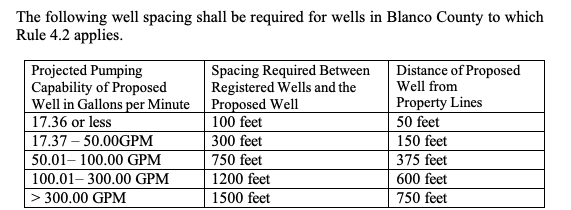
The owner of a proposed new well who, due to the peculiarities of the property shape or the local geology or hydrology, may need to locate a well closer than the above spacing requirements may apply for a variance of the spacing requirements under this Rule, in accordance with Rule 1.6. Except for proposed new wells on tracts of land that were subdivided prior to February 11, 2002, or for the drilling of replacement wells, the owner requesting a variance from the property line spacing requirements shall provide proof to the District that notice has been mailed to any adjoining, affected property owner of the variance request by certified mail, return receipt requested, and may obtain a letter from adjoining, affected property owners indicating their agreement with the modification of the property line spacing requirements. The letter agreement from adjoining, affected property owners shall be submitted with the application for a variance to the District office prior to drilling the proposed well or subdividing the land. An agreement by an adjacent property owner will affect drilling options on their property by causing the distance requirements from property lines and distances between wells to be adjusted inward on their property. The Board may grant a variance without a letter agreement from the adjoining, affected landowner to ensure each landowner is able to recover their fair share of the aquifer. A variance granted without the letter agreement does not impact the spacing requirements for any wells drilled by the affected adjoining landowner.
New wells drilled to replace existing wells do not have to meet the spacing requirements between the original well and the new replacement well.
B. Minimum Tract Size
The District will work with other Blanco County officials to ensure that proposed new wells will be drilled in compliance with current minimum tract sizes or other tract or lot requirements or restrictions imposed or accepted by other Blanco County authorities.
C. Spacing from Potential Sources of Contamination
All new wells must comply with the distances given for separation of wells from sources of potential contamination in the Water Well Drillers Rules, 16 Texas Administrative Code § 76.1000(a)(1)–(4), as amended.
D. Spacing from Retail Public Utility Service Area or Community Water System
In order to minimize the drawdown of the water table, minimize the reduction of artesian pressure, control subsidence, prevent interference between wells, prevent the degradation of the quality of groundwater, prevent waste of groundwater, preserve historic use of groundwater, and give consideration to the service areas of retail public utilities, all new wells other than those belonging to the retail public utility or the community water system shall be required to be spaced such that they are located a minimum of fifty feet (50 feet) outside the service area of a retail public utility or community water system unless additional spacing is required.
The District may approve a variance to this Rule, in accordance with Rule 1.6, for an owner desiring to drill a well within the service area of a retail public utility or community water system. The owner requesting such a variance shall provide the District with sufficient documentation to prove that either (1) the retail public utility or community water system will not or cannot provide water service to the tract of land on which the well is proposed to be drilled; or (2) the well is exempt under Texas Water Code 36.117(b).
E. Clustering of wells
If in the case of development of multiple wells by a single owner on the same tract of land and for geological or hydrological reasons, it is desired to cluster wells, the District shall consider, and may approve, such a request provided the spacing requirements are achieved as follows:
Retail public utilities and community water systems may apply to drill new wells, replacement wells, or monitor wells within the confines of a well field owned by the utility without regard for District spacing requirements if the site plan for the proposed new well and the well field has been designed by a professional engineer and has been approved by the TCEQ.
4.3 Well Construction Standards
Construction of wells and installation of pumps shall be in accordance with the Texas Occupations Code Chapter 1901, “Water Well Drillers” and Chapter 1902, “Water Well Pump Installers,” as amended and the Administrative Rules of the Texas Department of Licensing and Regulation, 16 Texas Administrative Code (TAC), Chapter 76, as amended, and additional standards as required in this Rule.
In order to prevent the degradation of the quality of groundwater, the Board has determined that, in addition to the requirements in the above statutes, the following practices shall be required for well construction in Blanco County.
A. Mandatory Watertight Sanitary Seal Requirements for Wellheads
To prevent pollutants from entering the wellhead, all wells shall be completed with a watertight sanitary seal. Any existing well not meeting this requirement is required to comply with this Rule at the time the wellhead is next removed. Wells with odd-sized casing or those having well heads for which there is no factory made watertight sanitary seal available shall be completed or modified in such a manner to meet the intent of this Rule.
B. Enhanced Grouting and Aquifer Isolation Standards
For new wells other than monitor wells, the annular space and grouting requirements under 16 TAC 76.1000(a)(1) is increased from ten feet to fifty feet (50 feet). If the top of the first potable water bearing strata is less than fifty feet below the surface, the General Manager may grant a field approval and this fifty feet distance can be reduced to a depth just above the first potable water bearing strata, but in no case shall be less than ten feet.
If a proposed well penetrates either the Edwards-Trinity (Plateau), Upper Glen Rose (Upper Trinity), or Marble Falls aquifers, with the intention of producing groundwater from an underlying aquifer, the well shall be grouted to a depth that will prevent flow of groundwater from those aquifers into the underlying aquifers.
C. Inspection Access Requirements
All wells shall be equipped with an inspection port, inspection tube, or some other means that will allow free and clear vertical access to the water table for the purposes of measuring water levels or disinfecting a well. Control boxes, pipes, fittings, or other wellhead equipment shall not hinder access to the inspection port. Electrical cables must be secured or taped to the production pipe in such a manner that will not restrict access for measurement of water levels and will reduce possible entanglement with water level measuring tapes or e-lines.
D. Vent Installation and Removability Requirements for Inspection Ports
Well vents may be installed in threaded inspection ports or the PVC inspection tube provided that the vent is constructed in such a manner that it may be easily removed and reinstalled as necessary for disinfecting a well or for measuring water levels.
E. Inspection Tube Installation Requirements for Wells with Centralizers
If production pipe centralizers or stabilizers are used in nonexempt well in such a manner that they may block e-line access to the water level, an inspection tube shall be installed for purposes of disinfecting a well and measuring water levels. The inspection tube must be at least ¾ inch diameter PVC in wells with casing less than 6 inches in diameter, or 1-inch diameter PVC in wells with a casing of 6-inch diameter or larger. It must be installed parallel to the production pipe, capped on the bottom, and have sufficient perforations to allow rapid and free flow of water to the inside of the tube. The tube must extend from the sanitary seal to just above the pump.
4.4 Sealing, Capping, or Plugging Wells
A. Sealing Wells
Following the procedure of Rule 9.1.B., the District may require the sealing of a well that is in violation of District Rules or that has been prohibited from producing groundwater. The reasons for requiring the sealing of a well include: (1) failure to apply for an Operating Permit prior to drilling a nonexempt well; (2) operating a nonexempt well without an Operating Permit; (3) exceeding the production limits when the well is located within a Critical Groundwater Depletion Area (CGDA); or (4) when the Board has denied, cancelled, or revoked an Operating Permit.
If the owner fails to seal the well, District staff is authorized to provide notice of intent to access the well for the purpose of sealing the well pursuant to Section 36.123 and Rule 4.5. Upon accessing the well, District staff or agents may seal or deactivate the well by physical means, tag it to indicate that the well has been sealed by the District, or take any other appropriate action necessary to clearly indicate that the well has been sealed or deactivated. The seal is intended to preclude operation of the well or identify unauthorized operation of the well.
Tampering with, altering, damaging, removing, or violating the seal of a sealed well in any way, or pumping groundwater from a well that has been sealed constitutes a violation of District Rules and subjects the person who performs that action, as well as the well owner who authorizes, allows, encourages, or condones such action, to enforcement and penalties pursuant to all applicable District Rules.
B. Capping Wells
The District requires any open or uncovered well that is in a non-deteriorated condition to be capped to prevent waste, pollution, or deterioration. The well shall remain capped until conditions that led to the capping are eliminated. The cap shall provide a sanitary seal to prevent the introduction of potential contaminants and shall be capable of sustaining a weight of at least four hundred (400) pounds. If the owner fails to close or cap the well in compliance with District Rules, the District may, following 10 days’ notice, go onto the land and close or cap the well. Reasonable expenses incurred by the District in closing or capping a well constitute a lien on the land on which the well is located pursuant to Section 36.118, Water Code.
C. Plugging Wells
Not later than the 180th day after the date a landowner or other person who possesses a deteriorated or abandoned well learns of its condition, the well shall be plugged in accordance with the Rules of the Texas Department of Licensing and Regulation, 16 Texas Administrative Code, Chapter 76, as amended. It is the responsibility of the landowner to ensure that such a well is plugged in order to prevent pollution of the groundwater and to prevent injury to persons. Prior to plugging the well, the well owner shall submit a plugging plan to the District. Not later than the 30th day after the date the well is plugged, a driller, licensed pump installer, or well owner who plugs an abandoned or deteriorated well shall submit a completed State of Texas plugging report to the District, as required by Texas Occupations Code, Section 1901.255(d).
If the owner fails to plug the well in compliance with State law, the District may:
(1) following 10-days’ notice and the procedures of Rule 4.5, go on the land and plug the well. Reasonable expenses incurred by the District in plugging a well constitute a lien on the land on which the well is located pursuant to Section 36.118; or
(2) as authorized by Texas Occupations Code, Section 1901.256, otherwise enforce Section 1901.255 related to landowners that have an abandoned or deteriorated well located on their property.
4.5 Access: Well and Property
The District has authority under Section 36.123 to enter any public or private property in Blanco County at any reasonable time for purposes of inspecting and investigating conditions relating to water quality, wells, or compliance with District Rules, regulations, permits, or other orders. The District respects individual property rights and shall endeavor to minimize any inconvenience to property owners while conducting District business. Whenever possible, District employees and agents shall notify, coordinate, and schedule well and property access in advance with the property owner, his agent, tenant, or other local contact. Notice is not required if prior permission to enter land or access wells has been granted by the property owner, his agent, tenant, or other local contact. District employees or agents accessing public or private wells or property shall exhibit proper credentials upon request. District employees or agents acting under this authority shall observe all applicable rules and regulations concerning safety, internal security, and fire protection. If unexpected, emergency, or critical conditions require District employees or agents to access public or private wells or property without prior access arrangements, the General Manager shall, at the first reasonable opportunity, contact the property owner, his agent, tenant, or other local contact. The General Manager shall inform him of the District’s accessing the well or property, the reasons for the District access, and provide the property owner with any pertinent information or action resulting from the District’s access.
5.1 Groundwater Database and Scientific Investigations
A. Well and Aquifer Database Management for Science and Planning
The District shall create and maintain, individually, through joint planning, and with assistance from the Texas Water Development Board (TWBD), a database of information on wells and aquifers located within Blanco County to provide for the best available science and develop DFCs, issuing permits and permit amendments, and managing the aquifer. District shall locate, collect, and add existing data to this database as opportunity permits. District staff shall acquire new data through a variety of aquifer studies, including water level measurements, water quality testing, hydrological testing, aquifer surveys, geophysical well logging, and other appropriate research or scientific investigations. The District shall periodically review the accumulated data to better understand and manage the groundwater resources in Blanco County.
B. Research Projects and Well Owner Cooperation
Pursuant to Section 36.107 and Section 36.109, the District shall implement any research projects or scientific studies and collect any information deemed necessary by the Board including groundwater use, water conservation, aquifer recharge, groundwater quantity and quality, aquifer conditions, geology, hydrology, hydrogeology, and other groundwater related fields. Pursuant to Rule 4.5 and Section 36.123, well owners shall cooperate with District research projects and scientific studies.
C. Joint Planning and Desired Future Conditions
The District will participate in joint planning with other groundwater conservation districts in Groundwater Management Area 9 to establish and review DFCs for relevant aquifers. The District shall conduct public hearings on proposed DFCs, consider evidence and stakeholder input, and adopt and revise DFCs consistent with §36.108 and other applicable provisions in Chapter 36 and the Texas Government Code. The District shall submit adopted DFCs to TWDB for review and certification, and shall revise its Groundwater Management Plan to incorporate the adopted DFCs and Modeled Available Groundwater values determined by TWDB.
5.2 Establishment of a Critical Groundwater Depletion Area
The Board may restrict the permitted annual production amount from wells requiring an Operating Permit if the Board determines that scientific data clearly indicate that one or more of the following conditions exist and that the regulation of production will minimize the drawdown of the water table or the reduction of artesian pressure: that the District, or a portion of the District, is experiencing (1) a lowering of the water table or a reduction in artesian pressure to such a degree that aquifer mining is occurring; (2) subsidence, interference between wells, degradation of water quality, negative impacts on historic use or retail public utilities; or (3) other adverse groundwater quantity or quality conditions.
A. Designation of a Critical Groundwater Depletion Area
If District research, scientific investigations, or groundwater and aquifer data indicate that adverse groundwater conditions exist, the Board may designate the area as a Critical Groundwater Depletion Area.
B. Critical Groundwater Depletion Area Designation Procedures
(1) The Board shall hold a public hearing on the proposed CGDA. The District will provide information to interested parties and accept public comment regarding the proposed Rule designating a CGDA.
(2) The public hearing must be held in accordance with the District public hearing Rules. 8.2.
(3) The Board will evaluate the comments received during the public comment period and during the public hearing, and consider all available information and data in their deliberations on the merits of designating a CGDA. The Board may designate and delineate a CGDA by amending the District Rules. Any CGDA so designated must be consistent with the District’s Groundwater Management Plan.
(4) The designation of a CGDA shall specify what adverse groundwater conditions are being addressed by the CGDA. The CGDA may be either temporary or permanent. If the CGDA is to be temporary, the Board shall set the duration or set specific criteria that, once achieved, will result in the termination of the CGDA. In no event shall a temporary CGDA endure longer than two years without official Board action extending it or converting it to a permanent CGDA. The designation of a temporary CGDA may be based on data indicating that aquifer mining is occurring due to unusual climatic conditions, periods of extended drought, or other conditions that may affect groundwater on a temporary basis.
(5) Once a temporary CGDA has been in existence for a period of two years the District shall consider whether to terminate or renew the Rules designating the CGDA. After notice and hearing, the Board shall determine whether the available data indicates that continued production limits are the only reasonable mitigation effort to adequately address the adverse groundwater conditions requiring designation of the CGDA. The Board may repeal the Rules designating the CGDA, or amend the Rules to extend the term of the temporary CGDA an additional two years, or convert it to a permanent CGDA.
C. Administration of a Critical Groundwater Depletion Area
(1) Once a CGDA has been designated and delineated by the Board, the area shall be given a unique name for identification purposes.
(2) All owners of permitted wells shall be notified of the existence of the CGDA and any new regulatory requirements by certified mail.
(3) The owners of permitted wells within the CGDA shall provide the District with reports of groundwater production from each well they own or operate within the CGDA. These reports shall be on forms provided by the District and shall be submitted to the District at intervals required by the District. Production volumes shall be calculated using as accurate a method as possible to estimate pumping volume, such as recording pumping times and rates in gallons per minute. If the Board has required flow-measuring devices in accordance with the paragraph below, the owner shall submit the actual production indicated by the measuring device.
(4) The Board may require all permitted wells within the CGDA to be equipped with a District approved flow meter or other measuring device at the well owner’s expense.
(5) The Board may set a maximum annual total production volume for the CGDA. In order to reduce or eliminate aquifer mining, the total annual production from all wells, both exempt and nonexempt, must not exceed the maximum annual total production volume set by the Board.
(6) The Board may set or allocate production limits on all permitted wells within the CGDA in order to help bring the total pumping volume within acceptable production limits to reduce or eliminate aquifer mining. The Board shall determine and allocate the volume of water that may be produced based on historical usage, generally accepted industry standards, types of use, special or unusual water supply needs, human or animal health, safety, or welfare needs, local Modeled Available Groundwater quantities, local groundwater quality, local geology and hydrology, alternative water sources, or any other criteria authorized by law. Exceeding the Board-
(7) authorized production limit of a permitted well located within a CGDA shall be a violation and may subject the well owner to enforcement action under District Rules.
(8) The Board shall consider the conditions within the CGDA, how a proposed well may affect the CGDA, whether additional groundwater production is available based on the current Modeled Available Groundwater, and, if available, how much shall be allocated to the proposed well. Based on these considerations, the Board may approve, deny, or modify Operating Permits within the CGDA.
(9) The Board shall notify the owners of exempt wells about the CGDA and request their cooperation in conserving groundwater, using groundwater more efficiently, and avoiding waste of groundwater.
(10) The Board shall review the status of the CGDA at least every two years and shall evaluate all pertinent data concerning the CGDA, and amend District Rules as necessary to accomplish the purposes of the CGDA. Changes or other Board action may include, but are not limited to, production limit increases or decreases for all or part of the CGDA, production limit increases or decreases for specific permitted wells, removal of specified land areas from the CGDA, addition of specified land areas to the CGDA, and identification of any permitted wells exceeding their annual production allocation. Any changes shall require the Board to go through the notice and hearing procedure required by this Rule. Any changes shall be communicated to the owners of all permitted wells within the CGDA by written notice and all landowners by notice published in one or more local newspapers.
(11) An owner of a permitted well within a CGDA may request a temporary increase or decrease in the annual water allocation through petition to the Board on a case-by-case basis, in accordance with Rule 1.6. Should the Board determine that such a variance is justified and is consistent with the purposes of the CGDA or the District Rules, the District Management Plan and the current Modeled Available Groundwater quantities, prudent aquifer management practices, and does not exceed the maximum annual total production for the CGDA, the Board may grant a temporary variance for an individual well.
5.3 Declaration of an Aquifer Emergency Warning
A. Declaration for Hazardous Groundwater Conditions
The Board or the General Manager may act to protect groundwater and aquifer users by declaring an Aquifer Emergency Warning if the Board or the General Manager determines that scientific data or other evidence clearly indicates that the District, or a portion of the District, is experiencing hazardous groundwater conditions that require immediate action on the part of the District. Groundwater conditions that require immediate action are those that may be hazardous to the health, safety, and welfare of the residents or livestock in Blanco County. Hazardous conditions include, but are not limited to, contamination of groundwater due to hazardous material pollution, the presence of any chemical contaminant whose concentrations exceed Safe Drinking Water Standards, the presence of any bacteria or bacterial concentrations that threaten human or animal health, safety, or welfare, and any other water quality condition the Board or the General Manager determines to be of immediate threat to the groundwater of Blanco County.
B. Notification Procedures
Upon declaring an Aquifer Emergency Warning by the Board or the General Manager, the District will contact all appropriate authorities to inform them of the Aquifer Emergency Warning and the reasons for its declaration. Those agencies contacted shall include, as appropriate, t, Texas Railroad Commission, Blanco County Health Department, Texas Department of Health, Blanco County Sheriff’s Office, Blanco Mayor’s Office and Police Department, Johnson City Mayor’s Office and Police Department, Blanco County Judge and Blanco County Commissioners, and local newspapers.
C. Notification and Protective Guidance for High-Risk Property Owners
If the District determines that certain property or well owners may be at high risk due to the nature of the Aquifer Emergency Warning, the District will attempt to contact them on an individual basis in order to alert them to the hazardous conditions and offer suggestions on implementing appropriate protective measures.
D. Mandatory Public Meeting Within 14 Days of Emergency Declaration
The District shall hold a public meeting within 14 days following the declaration of an Aquifer Emergency Warning to more fully inform the public about the nature of the Aquifer Emergency Warning and explain the steps undertaken by the District to mitigate the hazardous conditions. The District may provide suggestions, advice, and recommendations to Blanco County residents on ways to address the hazardous conditions or implement protective measures.
E. Post-Emergency Investigation and Analysis of Hazardous Conditions
The District will initiate further studies and analysis within the area affected by the aquifer emergency warning. The District investigations will seek to determine the extent and severity of the hazardous condition, whether the hazardous conditions are temporary or permanent, if restrictive measures have improved the hazardous conditions, what further actions may be necessary to mitigate or alleviate the problem, and how similar hazardous conditions may be prevented in the future.
F. Duration and Cancellation of Aquifer Emergency Warnings
The Aquifer Emergency Warning shall be in effect until cancelled by the Board. The Board shall cancel the Aquifer Emergency Warning upon notification by a competent state or local authority that the hazardous condition is no longer a concern, or if scientific evidence indicates that the hazardous conditions no longer exist or no longer pose a threat.
6.1 Waste and Pollution
A. General Prohibition
No person shall intentionally or negligently commit waste or pollution of the groundwater resources of Blanco County.
B. Wasteful Use
Groundwater produced from within the District may not be used in such a manner or under such conditions as to constitute waste.
C. Wasteful Production
Any person producing or using groundwater shall use every possible precaution, in accordance with the most acceptable and approved methods, to stop and prevent waste of groundwater.
D. Groundwater Pollution
No person shall pollute or harmfully alter the character of the groundwater in Blanco County by causing or allowing the introduction of undesirable water, pollutants, or other deleterious matter from another stratum, from the surface of the ground, or from the operation of a well.
E. Orders to Prevent Waste or Pollution
After providing notice to affected parties and holding a public meeting, the Board may adopt orders necessary to prohibit or prevent waste or pollution. If the Board or the General Manager determines that an emergency exists requiring the immediate entry of an order to prohibit waste or pollution and protect the public health, safety, and welfare, a temporary order may be entered without notice and hearing in accordance with District Rule 5.3. A public meeting shall be held within 14 days of issuance of an emergency Board order under this Rule 6.1.E. at which the Board shall either revoke, amend, or confirm the order.
If the District has identified a person responsible for the waste or pollution of groundwater and an emergency exists, it may issue a temporary order, and then as soon as possible, proceed with enforcement against the responsible person.
7.1 Introduction
The District may designate the various drought conditions and implement the applicable provisions of this Rule upon determination that such implementation may be necessary for the conservation, preservation, protection, recharging, and prevention of waste of the groundwater in Blanco County or to protect and preserve the public health, welfare, and safety during drought situations or periods of low rainfall.
7.2 Application
Provisions of this Rule shall apply to all Blanco County wells and all persons or organizations owning or operating any well(s) producing groundwater within Blanco County, regardless of the size, pumping capacity, date drilled, water usage, ownership, or the exempt or non-exempt status of the well(s) other than wells used solely for domestic use or for providing water for livestock or poultry if the well is:
(A) located or to be located on a tract of land larger than 10 acres; and
(B) drilled, completed, or equipped so that it is incapable of producing more than 25,000 gallons of groundwater a day.
7.3 Drought Management by Watershed
For drought management purposes, the District has divided Blanco County into two watersheds, the Blanco River watershed and the Pedernales River watershed. This division is based on the hydrological, topographical, geological, and demographic differences of the groundwater and groundwater users of Blanco County. The two divisions will allow for more appropriate drought management and administrative actions and strategies. Furthermore, it is anticipated that District declarations of drought stages will be easier for the public to understand and relate to their specific property, well, and water usage. Such an approach during drought conditions will serve to coordinate and unify water conservation efforts between Blanco County residents who rely on private wells and the water conservation efforts of the municipal public water supply systems of the City of Blanco and the City of Johnson City.
Rather than adhere strictly to the topographical watershed divide between the two rivers, a more easily understood and identifiable watershed boundary will be used by the District. The two watersheds are defined as follows:
A. Blanco River Watershed:
Consists of Blanco County Commissioner Precincts 1 and 4.
The Trinity Aquifer lies primarily within the Blanco River watershed, which is one of the two most densely populated parts of Blanco County. With the exception of a small portion located in Kendall County, the headwaters of the Blanco River lie primarily in Blanco County. Thus, Blanco River flow is little influenced by rainfall outside of Blanco County. The Trinity Aquifer typically produces low to medium quantities of water, generally exhibits slow to moderate recharge rates, and often exhibits relatively rapid declines in water levels, particularly during periods of high usage or drought conditions. The City of Blanco owns several wells but currently relies exclusively on surface water for the needs of its water utility customers.
It is the intent of the District to closely unify drought management efforts in the City of Blanco and with well owners located in the Blanco River Watershed and Blanco County Commissioner Precincts 1 and 4. However, initiation or termination of drought stages in the Blanco River Watershed and Precincts 1 and 4 is the sole responsibility of the District, which has the duty and authority to take independent drought management action as authorized by Chapter 36 and these Rules.
B. Pedernales River Watershed:
Consists of Blanco County Commissioner Precincts 2 and 3.
The Pedernales River watershed is less densely populated than the southern part of the county, except within the city limits of Johnson City. The residents in the Pedernales River watershed are served primarily by wells producing groundwater from the Ellenburger, Hickory, and, to a lesser extent, the Trinity Aquifer and a few other minor aquifers. The Ellenburger Aquifer and Hickory Aquifer produce small to large quantities of water, depending on location, and tend to recharge more rapidly than the Trinity Aquifer. The Pedernales River drains a large area west of Blanco County and is heavily impacted by rainfall events upstream in Gillespie County and areas further west. Recharge in the Pedernales River watershed appears to be closely related to both the higher flow in the Pedernales River and eastward migration of groundwater from areas west of Blanco County.
The City of Johnson City has prepared a Water Conservation and Drought Contingency Plan/Ordinance which is applicable to all customers served by the City of Johnson City Public Water System. The Ordinance is based primarily on quantified reductions in specific capacity and pumping times for their public water supply wells, which are located in the Ellenburger Aquifer. The District will seek to correlate Johnson City public well hydrological conditions with Ellenburger Aquifer monitor well water levels. Many rural residents in the Pedernales River Watershed also rely on wells producing from the Ellenburger Aquifer, and water level changes in their wells will likely be comparable to changes in the Johnson City wells.
It is the intent of the District to closely unify drought management efforts in Johnson City and with well owners located in the Pedernales River Watershed and Blanco
County Commissioner Precincts 2 and 3. However, initiation or termination of drought stages in the Pedernales River Watershed and Precincts 2 and 3 is the sole responsibility of the District, which has the duty and authority to take independent drought management action as authorized by Chapter 36 and these Rules.
7.4 Triggering Criteria for Initiation and Termination of Drought Stages
Drought Stages will be initiated or terminated by specific watershed. Drought Stages and the associated conservation and management practices shall apply only to the specific watersheds designated and described in Rule 7.3. Declarations of initiation or termination of Drought Stages will be provided to Blanco County newspapers, posted at the District Office, or communicated to well owners in such a manner as may be deemed necessary by the District.
A. Initiation of Drought Stages
The District will maintain an ongoing aquifer water level monitoring program to provide the District with data to help identify the onset of drought conditions and stages of severity. The District will also monitor any declarations of drought stages by the City of Blanco and the City of Johnson City and take note of the triggering conditions which warranted such declarations. The District General Manager and District Staff shall review the water levels in the District Monitor Wells and determine if groundwater levels in either the Blanco River Watershed or the Pedernales River Watershed have arrived at any drought trigger level designated on the current District Drought Stage Schedule. Once the trigger level has been exceeded for seven days or more, the General Manager may initiate the appropriate Drought Stage immediately, or if aquifer, meteorological, Palmer Drought Index, or other conditions exist that need to be addressed by the Board of Directors, the General Manager may bring the matter to the attention of the Board of Directors for their review and possible action. The Board may consider the matter, along with any recommendations provided by the District Staff, and may declare the initiation of any of the Drought Stages warranted by this Rule.
B. Termination or Reduction of Drought Stages
The General Manager and District Staff shall review the water levels in the District Monitor Wells and determine if groundwater levels in either the Blanco River Watershed or the Pedernales River Watershed have remained above any drought trigger level designated on the current District Drought Stage Schedule or if significant recharge conditions are occurring. In either case, the District General Manager may terminate drought conditions or reduce the current Drought Stage to one that is appropriate without prior Board review or action. The Board may consider the matter, along with any recommendations provided by the District Staff, and may declare the termination or reduce the current Drought Stage.
7.5 Drought Stages
District Drought Management consists of four Drought Stages, which are generally comparable to the Drought Stages and trigger conditions designated by the City of Blanco and the City of Johnson City.
A. Stage One: Mild Drought
(generally comparable to City of Blanco Stage 1 and Johnson City Stage 1 or 2)
B. Stage Two: Moderate Drought
(generally comparable to City of Blanco Stage 2 and Johnson City Stage 3)
C. Stage Three: Severe Drought
(generally comparable to City of Blanco Stage 3 and Johnson City Stage 4)
D. Stage Four: Critical Drought or Groundwater Emergency
(generally comparable to City of Blanco Stage 4 and Johnson City Stage 5 or 6)
7.6 Groundwater Conservation Goals and Usage Reduction Measures
Water conservation goals and groundwater usage reduction measures and restrictions are defined in this Rule. They are comparable to the goals, reductions, and restrictions incorporated by the drought contingency plans of the City of Blanco and the City of Johnson City. However, this District Rule more closely addresses the uses, needs, concerns, and compliance capabilities of well owners and users, most of which are outside the service areas of retail public utilities and community water supply systems.
A. Stage One: Mild Drought
Conservation Goal: 5-10% reduction in groundwater use
Usage Reduction Measures:
• Continue, or increase, voluntary reduction in various uses
• Check for and correct all plumbing leaks
• Maintaining more than 50,000 gallons of groundwater in ponds, lakes, tanks, reservoirs, or other surface impoundments for holding water is prohibited except for those wells permitted for non-domestic irrigation.
B. Stage Two: Moderate Drought
Conservation Goal: 20% reduction in groundwater use
Usage Reduction Measures:
• Continue, or increase, voluntary reduction in various uses
• Check for and correct all plumbing leaks
• Water outside lawns, trees, shrubs once every 5 to 7 days
• Water at night between hours of 8pm and 8am
• Keep swimming pools, landscape or decorative ponds, and fountains covered, use water recirculation, and refill only once every 5 to 7 days
• Wash vehicles at car wash only as needed
• No washing of buildings, driveways, streets, patios, or other outdoor surfaces except as required for human or animal health and safety needs, or for fire prevention
• Water livestock in leak-proof troughs as much as practical
• Maintaining more than 50,000 gallons of groundwater in ponds, lakes, tanks, reservoirs, or other surface impoundments for holding water is prohibited except for those wells permitted for non-domestic irrigation.
C. Stage Three: Severe Drought
Conservation Goal: 20-50% reduction in groundwater use
Usage Reduction Measures:
• Continue, or increase voluntary reduction in various uses
• Check for and correct all plumbing leaks
• Water outside lawns, trees, shrubs once every 5 to 7 days
• Water at night between hours of 8pm and midnight using hand-held hose with automatic shut-off nozzle or automatic timer
• Hose end sprinkler systems prohibited
• Wash vehicles at car wash only as needed
• No washing of buildings, driveways, streets, patios, or other outdoor surfaces except as required for human or animal health and safety needs, or for fire prevention
• Watering for dust control only when required by law
• Livestock watered in leak-proof troughs strongly recommended
• Pumping groundwater into livestock ponds is discouraged
• Providing groundwater to ponds, lakes, tanks, reservoirs, or other surface impoundments for holding water is prohibited.
D. Stage Four: Critical Drought or Groundwater Emergency
Conservation Goal: 50% + reduction in groundwater use
Usage Reduction Measures:
• Continue, or increase, voluntary reduction in various uses
• Check for and correct all plumbing leaks
• No outside watering of lawns, trees, shrubs, or gardens
• No vehicle washing
• No washing of buildings, driveways, streets, patios, or other outdoor surfaces except as required for human or animal health and safety needs, or for fire prevention
• Watering for dust control only when required by law
• Livestock watered in leak-proof troughs only
• Providing groundwater to ponds, lakes, tanks, reservoirs, or other surface impoundments for holding water is prohibited.
7.7 Municipal Compliance
The BPGCD recognizes that the City of Blanco’s current Water Conservation and Drought Management Plan and the City of Johnson City’s current Water Conservation and Drought Contingency Plan are generally compatible with this Drought Management Rule in providing drought management and groundwater conservation purposes within the municipal water service areas of the City of Blanco and the City of Johnson City. The District will work with the City of Blanco and the City of Johnson City during any declared Drought Stage to ensure continued compatibility with this Rule.
7.8 Enforcement
The District will rely primarily on voluntary compliance with this Rule. Persons who are found to be in non-compliance with District Drought Management Rules will be contacted by District Staff. District Staff will explain the drought conditions, District Rules, and the need for everyone to comply with a County-wide effort to conserve groundwater during times of drought in order to reduce the impacts of drought on all aquifer users. Past experience by other groundwater districts has proven that such information-based enforcement efforts are an effective method of achieving compliance with District Rules while building local cooperation and consensus among well owners and well users. However, persons who repeatedly violate District Rules will be subject to additional requests for compliance and may be subject to other remedies authorized under District Rule 9, Chapter 36, or other applicable laws or codes of the State of Texas.
Rule 8 Procedural Rules
8.1 Repealed.
Amended to be effective 8/15/06 by Board Resolution 081506-01 on 8/15/06. Amended to be effective 9/21/17 by Board Order on 9/21/17. Repealed to be effective 4/16/2026 by Board Resolution 20260116-5 on 4/16/2026.
8.2 Hearings Other Than Permit Hearings or Emergency Rules
A. Public Hearings for Rules and Depletion Area Proposals
Once the District has developed a plan or proposal involving its Rules or designation of a Critical Groundwater Depletion Area, the District will schedule a public hearing on the proposal. The public hearing may be conducted during a regular or called meeting of the Board of Directors, and the Board may take action during the same meeting or at any subsequent meeting noticed in compliance with the Open Meetings Act.
B. Comprehensive Notice Requirements for Contested Case Hearings
In addition to the notice required by Chapter 36 or the Open Meetings Act, not later than 20 days before the date of the hearing, notice shall be:
(1) posted in a place readily accessible to the public at the District office;
(2) provided to the county clerk of Blanco County for posting at the County Courthouse;
(3) published in one or more newspapers of general circulation in Blanco County; and
(4) provided by mail, facsimile, or electronic mail to any person who has requested notice under Rule 8.2.E. Failure to provide individual notice does not invalidate an action taken by the District at the hearing.
C. Public Hearing Notice Content for Rules and Depletion Areas
Notice of the hearing shall include:
(1) The time, date, and location of the hearing.
(2) A brief explanation of the subject of the hearing.
(3) The agenda of the hearing.
(4) If the hearing is for the purpose of considering amendments to the District rules, the location or Internet site where the proposed rules may be reviewed or copied and the deadline for submitting written comments.
D. Public Availability of Proposed Rules and Depletion Area Plans
Copies of the proposal shall be available during normal business hours at the District Office or shall be posted on the District’s Internet site.
E. Annual Request Requirement for Individual Hearing Notices
A person may submit to the District a written request for individual notice of a hearing. A request is effective for the remainder of the calendar year in which the request is received by the District and a new request must be filed each calendar year.
F. Deadline for Written Comments on Proposed Rules and Depletion Areas
Anyone interested in the proposal may submit written comments about the proposal to the District at least 5 days prior to the scheduled hearing at which the proposal will be considered by the Board.
G. Oral Comment Opportunity at Public Hearings
Anyone interested in the proposal may attend the hearing and make oral comments at the time designated for comments.
H. Hearing Compliance and Audio Recording Requirements
When conducting the hearing, the District will comply with Chapter 36 and the Open Meetings Act and will make and keep in its files an audio recording of the hearing.
I. Written Order and Attachment Requirement for Board Decisions
The Board will issue a written order or resolution reflecting its decision. The proposal that the Board has approved will be an attachment to that written order or resolution.
J. Effective Date and Finality of Board Orders on Proposals
The effective date of the written order or resolution shall be the date on which the President of the District signs the order or resolution. The order or resolution shall include a statement that the proposal becomes effective and final on that date. Any appeal authorized by law shall run from the date on which all administrative appeals to the district are final.
8.3 Adoption of Emergency Rules
A. Emergency Rule Adoption Without Standard Notice and Hearing
The District may adopt an emergency rule without following the notice and hearing provisions of Rule 8.2, if the Board:
(1) Finds that a substantial likelihood of imminent peril to the public health, safety, or welfare, or a requirement of state or federal law, requires adoption of a rule on less than 20 days’ notice; and
(2) Prepares a written statement of the reasons for its finding.
B. Open Meetings Act Requirement for Emergency Rule Adoption
An emergency rule must be adopted at a meeting of the Board subject to the requirements of the Open Meetings Act.
C. An emergency rule shall be effective for 90 days
If notice of a hearing to amend the rules is given before the emergency rule expires, the emergency rule is effective for an additional 90 days.
Amended to be effective 8/15/06 by Board Resolution 081506-01 on 8/15/06. Amended to be effective 9/21/17 by Board Order on 9/21/17.
8.4 Permit Actions by the Board
A. Public Hearing Scheduling Deadline for Complete Applications
Within 60 days of the date on which the District determines that an application is administratively complete, the General Manager shall call a public hearing to consider the application and the proposed action on that application, if any.
B. Public Hearing Notice Requirements and Content
Notice required by Chapter 36, Subchapter M, or the Open Meetings Act shall be provided for the meeting and shall include the name of the applicant, the address or approximate location of the well, the requested annual production amount, and a proposed action on that application, if any.
C. Applicant Publication and Website Posting for Hearing Notice
At least 10 days prior to the scheduled public hearing, the applicant shall publish notice in a format acceptable to the District in a newspaper of general circulation in Blanco County. The notice shall comply with Chapter 36, Subchapter M, and include the name of the applicant; the address or approximate location of the well; a brief description of what the application seeks, including the requested annual production amount; and a proposed action on the application, if any. The General Manager will post the same information on the District’s Internet website.
D. Mailed Notice to Applicant and Amendment Reprocessing
At least 10 days prior to the scheduled public hearing, the District shall mail notice of the hearing to the applicant. If the District receives an amended application after providing this notice, the application becomes administratively incomplete and must be reprocessed by the District.
E. Public Availability of Application Materials Prior to Hearing
Copies of the application, the applicant’s response to any notices of deficiency, and the proposed action on the application, if any, shall be available at the District Office prior to the meeting. These materials will be posted on the District Internet website at least 10 days prior to the hearing.
F. Public Comment Opportunities on Permit Applications
Anyone interested in the application may submit written comments about the application to the District prior to the scheduled meeting at which the application will be considered by the Board, or may attend the meeting to make oral comments at the time designated for comments.
G. Board Discretion to Administer Oaths During Application Hearings
The Board, at its sole discretion, may administer an oath to the staff, the applicant, and anyone who makes oral comments on the application.
H. Board Decision Timeline, Order Requirements, and Possible Outcomes
The Board shall issue a written order or resolution reflecting its decision. If the Board approves the application, the permit shall be an attachment to that written order or resolution. The Board’s decision shall be made within 60 days after the date the final hearing on the application is concluded. The Board may:
(1) if contested, send the application to a pre-hearing conference for standing or;
(2) issue the permit or;
(3) issue the permit with conditions or;
(4) deny the application.
I. Contested Case Appeal Process for Denied or Conditional Permits
If the Board votes to issue the permit with conditions or denies the permit, the applicant may contest the Board’s action by submitting a formal contested case letter to the District office within twenty (20) days after the Board’s vote. The application shall go before the Board as a contested case at the next available Board hearing.
J. Pre-Hearing Conference for Contested Case Requests
If the District receives a written request for contested case hearing made by a person other than the applicant the District shall schedule a pre-hearing conference within 35 days after the date of the request. The District shall determine at the pre-hearing conference whether a contested case hearing will be held. This determination will be based on whether the requesting person has standing and whether the request raises any justiciable issues.
8.5 Permit Actions Requiring a Contested Case Hearing
A. Timely request for contested case hearing
If the District receives a timely filed request for a contested case hearing, the application shall be set for an evidentiary hearing.
B. Open Meetings Act
Notice required by the Open Meetings Act shall be provided for the hearing if conducted by a quorum of the Board.
C. The evidentiary hearing must be conducted by:
(1) a quorum of the Board or an individual to whom the Board has delegated in writing the responsibility to preside as a hearings examiner over the hearing or matters related to the hearing. The Board President or the hearings examiner shall serve as the presiding officer at the hearing. If the hearing is conducted by a quorum of the Board and the President is not present, the Directors conducting the hearing may select a Director to serve as the presiding officer.
(2) Upon request of the applicant or of the protestant, the Board may delegate to the State Office of Administrative Hearings (SOAH) the authority to conduct hearings designated by the Board.
(a) If the Board refers a contested case hearing to SOAH, then the applicable rules of practice and procedure of SOAH (1 Tex. Admin. Code Ch. 155) govern any contested case hearing of the District, as supplemented by these rules and Chapter 36, Water Code.
(b) If the Board refers a contested case hearing to SOAH, the administrative law judge who conducts the contested case hearing shall serve as the hearing examiner and consider applicable District rules and policies in conducting the hearing. However, the District may not supervise the administrative law judge.
(c) If the Board refers a contested case hearing to SOAH, the District may not attempt to influence the findings of facts or the administrative law judge’s application of the law in a contested case hearing except by proper evidence and legal argument.
(d) If requested by the applicant or other party to a contested case, the District shall contract with the State Office of Administrative Hearings to conduct the hearing. The party must file such a request not later than the fourteenth (14) day before the date the evidentiary hearing is scheduled to begin. The Board order granting the contested case hearing may designate a location for the hearing inside the boundaries of the District or in Travis County at a location designated by SOAH. The party requesting the hearing before the SOAH shall pay all costs associated with the contract for the hearing and shall, five business days before the hearing begins, deposit with the District an amount sufficient to pay the contract amount. At the conclusion of the hearing, the District shall refund any excess money to the paying party.
(3) Only an affected person may request a contested case hearing. To determine whether a person requesting a contested case hearing is an affected person, the presiding officer shall consider the following:
1. whether the interest claimed is one protected by the law under which the application will be considered;
2. distance restrictions or other limitations imposed by law on the affected interest, including proximity to well locations, facilities, activities or groundwater resources affected by or related to the application;
(4) whether a reasonable relationship exists between the interest claimed and the activity regulated;
(5) likely impact of the regulated activity on the health, safety, and use of property of the person;
(6) likely impact of the regulated activity on use of the impacted natural resource by the person; and
(7) for governmental entities, their statutory authority over or interest in the issues relevant to the application.
D. Presiding Officer: Authority and Obligations
The presiding officer has the following authority and obligations:
(1) May convene the hearing at the time and place specified in the notice;
(2) May set any necessary additional hearing dates;
(3) May designate the parties regarding a contested application;
(4) May establish the order for presentation of evidence;
(5) May administer oaths to all persons presenting testimony;
(6) May examine persons presenting testimony;
(7) May ensure that information and testimony are introduced as conveniently and expeditiously as possible without prejudicing the rights of any party;
(8) Shall admit relevant evidence and may exclude evidence that is irrelevant, immaterial, or unduly repetitious;
(9) May prescribe reasonable time limits for testimony and the presentation of evidence;
(10) May allow testimony to be submitted in writing and may require that written testimony be sworn to. On the motion of a party to the hearing, the presiding officer may exclude written testimony if the person who submits the testimony is not available for cross-examination by phone, a deposition before the hearing, or other reasonable means.
(11) May refer parties to an alternative dispute resolution (ADR) procedure on any matter at issue in the hearing, apportion costs for ADR, and appoint an impartial third party as provided by Section 2009.053 of the Government Code to facilitate that procedure; and
(12) May continue a hearing from time to time and from place to place without providing notice. If the continuance is not announced on the record at the hearing, the presiding officer shall provide notice of the continued hearing by regular mail to the parties.
E. Hearing Record Requirements and Cost Allocation
The presiding officer shall prepare and keep a record of each hearing in the form of an audio or video recording or a court reporter transcription. On the request of a party to the contested case hearing, the hearing shall be transcribed by a court reporter. The costs of such court reporter may be assessed against the party requesting it or among the parties to the hearing. The presiding officer may exclude a party from further participation in the hearing for failure to pay in a timely manner costs assessed against that party under this Rule 8.5.E.
F. Hearings Examiner Report Requirements and Exceptions
If the Board has appointed a hearings examiner to be the presiding officer at the hearing, the hearings examiner shall submit a report to the Board not later than the 30th day after the date the hearing is concluded. A copy shall be provided to the applicant and each party to the hearing. The applicant and other parties to the hearing may submit to the Board written exceptions to the report within 10 days of issuance of the report. The report shall include:
(1) A summary of the subject matter of the hearing;
(2) A summary of the evidence received; and
(3) The hearing examiner’s recommendations for Board action on the subject matter of the hearing.
G. Board Decision Timelines and Order Requirements
The Board shall issue a written order or resolution reflecting its decision, which shall be made at the hearing or at a meeting subject to the requirements of the Open Meetings Act. A copy of the permit shall be an attachment to that written order or resolution. If a contested case is presided over by a majority of the Board, then the Board’s decision shall be rendered not later than the 60th day after the date on which the hearing is finally closed. If the Board refers a contested case to SOAH, then the Board’s decision will be rendered no more than 60 days after the final hearing is concluded unless the Board determines that there is good cause for extending the deadline. For contested case hearings conducted by SOAH, the Board decision on a Proposal for Decision must be made no later than the 180th day after the date the District received the final Proposal for Decision from SOAH. The Board is considered to have adopted a final proposal for decision of the administrative law judge as a final order on the 181st day after the date the administrative law judge issued the final proposal for decision if the board has not issued a final decision by:
(1) adopting the findings of fact and conclusions of law as proposed by the administrative law judge; or
(2) issuing revised findings of fact and conclusions of law.
H. Procedures and Deadlines for Rehearing Requests and Findings
Request for rehearing or findings and conclusions shall be considered as follows:
(1) Not later than the 20th day after the date of the Board’s decision, an applicant or a party to a contested hearing may administratively appeal a decision of the Board on an application by requesting written findings and conclusions or a rehearing before the Board.
(2) On receipt of a timely written request, the Board shall make written findings and conclusions regarding a decision of the Board on an application. The board shall provide certified copies of the findings and conclusions to the person who requested them, and to each designated party, not later than the 35th day after the date the Board receives the request. The applicant or a party to the contested case hearing may request a rehearing before the Board not later than the 20th day after the date the Board issues the findings and conclusions.
(3) A request for rehearing must be filed in the District office and must state the grounds for the request. The person requesting a rehearing must provide copies of the request to all parties to the hearing. The Board must consolidate requests for rehearing filed by multiple parties to one contested case hearing, but only one rehearing may be held per application.
(4) If the Board grants a request for rehearing, the Board shall schedule the rehearing not later than the 45th day after the date the request is granted. Any action by the Board on a request for rehearing shall be made at a Board meeting subject to the Open Meetings Act.
(5) The Board shall make a final decision on the application not later than the 90th day after the date of the decision by the Board that was subject to the motion for rehearing. The failure of the Board to grant or deny a request for rehearing before the 91st day after the date the request is submitted is a denial of the request.
I. Conditions for Finality of Board Decisions
A decision by the Board on an application is final if:
(1) A request for rehearing is not filed on time, on the expiration of the period for filing a request for rehearing; or
(2) A request for rehearing is filed on time, on the date:
(a) the Board denies the request for rehearing; or
(b) the Board renders a written decision after rehearing.
J. Judicial Appeal Deadline and Rehearing Prerequisite
An applicant or a party to a contested hearing may file a suit against the District under Texas Water Code § 36.251 to appeal a decision on an application not later than the 60th day after the date on which the decision becomes final. A timely filed request for rehearing is a prerequisite to any such suit.
8.6 Hearings On Enforcement Actions
A. Enforcement, Scheduling, and Public Hearings
If the District receives a timely filed written request for hearing from a Respondent who has received a notice of violation from the District, the District shall decide at which Board meeting the enforcement action will be considered. The Board meeting at which the enforcement action is considered under this Rule shall be considered the public hearing on the matter and fulfills the requirement, if any, for a public hearing.
B. Open Meetings Law Notice Requirement
Notice required by the Open Meetings Law shall be provided for the meeting.
C. Certified Mail Notice Requirement for Enforcement Hearings
Notice of the hearing on the enforcement action shall be mailed to the Respondent by certified mail, return receipt requested, at least ten days prior to the scheduled hearing date.
D. Opportunity for Oral Comments at Enforcement Action Meetings
Anyone attending the meeting on the enforcement action may make oral comments at the time designated for comments.
E. Board Discretion to Administer Oaths During Enforcement Actions
The Board, at its sole discretion, may administer an oath to the staff, the Respondent, and anyone who makes oral comments on the enforcement action.
F. Appointment of Hearing Officer or Committee for Enforcement Actions
The Board, at its sole discretion, may appoint a Hearings Officer or committee of the Board to conduct the hearing on the enforcement action (Hearing Body). Any hearing conducted by a Hearing Body, shall be conducted in the same manner as provided in this Rule 8.6. At the close of the hearing, the Presiding Officer shall make a written recommendation to the Board. The recommendation shall become part of the record. The Board is not required to approve the recommendation of the Hearing Body.
G. Written Order or Resolution Requirement for Board Decisions
The Board shall issue a written order or resolution reflecting its decision.
H. Effective Date and Finality of Board Orders
The effective date of the written order shall be the date on which the President of the District signs the order or resolution. The order or resolution shall include a statement that the order or resolution becomes effective and final on that date. Any appeal authorized by Texas Water Code Chapter 36, Subchapter H shall run from the effective date, because it is the date on which all administrative appeals to the district are final.
9.1 Enforcement Policy in General
The District realizes that many Rule violations are unintentional and will make every effort to encourage voluntary compliance with District Rules. In general, the District will attempt to encourage voluntary compliance in the following manner: (1) personal contact, if possible, (2) sending a Notice of Violation by First Class Mail from the District, (3) sending a Notice of Violation by Certified Mail from the District. If these efforts at voluntary compliance are unsuccessful, or if the violation is particularly egregious, the District may then proceed to a sending a Notice of Violation by Certified Mail from District Legal Counsel detailing the alleged violations and the legal ramifications. Unresolved Rule violations may be placed on a District Board of Directors Meeting agenda for action and possible assessment of penalties available to the District under the authority of Chapter 36.
9.2 Civil Enforcement
As authorized by Texas Water Code Section 36.102, the District may recover from any person for breach of any rule of the district in an amount not to exceed $25,000 per day per violation, and each day of a continuing violation constitutes a separate violation. In addition, the District may seek recovery of attorney’s fees, costs for expert witnesses, and any other costs incurred by the District before the court.
9.3 Notice of Violation
To initiate an enforcement action, the District shall provide written notice to a person who is believed to be in violation of law, including violation of a District Rule, Order, or permit. The notice shall include information about the violation and may require remedial action and may assess a penalty. The notice shall provide the opportunity for public hearing under Rule 8.6. Such written notice will be considered a Notice of Violation.
9.4 Settlement Schedule
The District may take enforcement action against well drillers, pump installers, well owners, property owners, permit holders, or any combination thereof for non-compliance with District Rules, including failure to comply with conditions of a permit issued by the District. The District may settle violations in accordance with the following schedule. If the District is required to file suit to enjoin any violation, that same suit will seek civil penalties of up to $25,000 per day per violation, and each day of a continuing violation, along with court costs, expert witness fees, and attorney’s fees.
Settlement Schedule for Non-Compliance